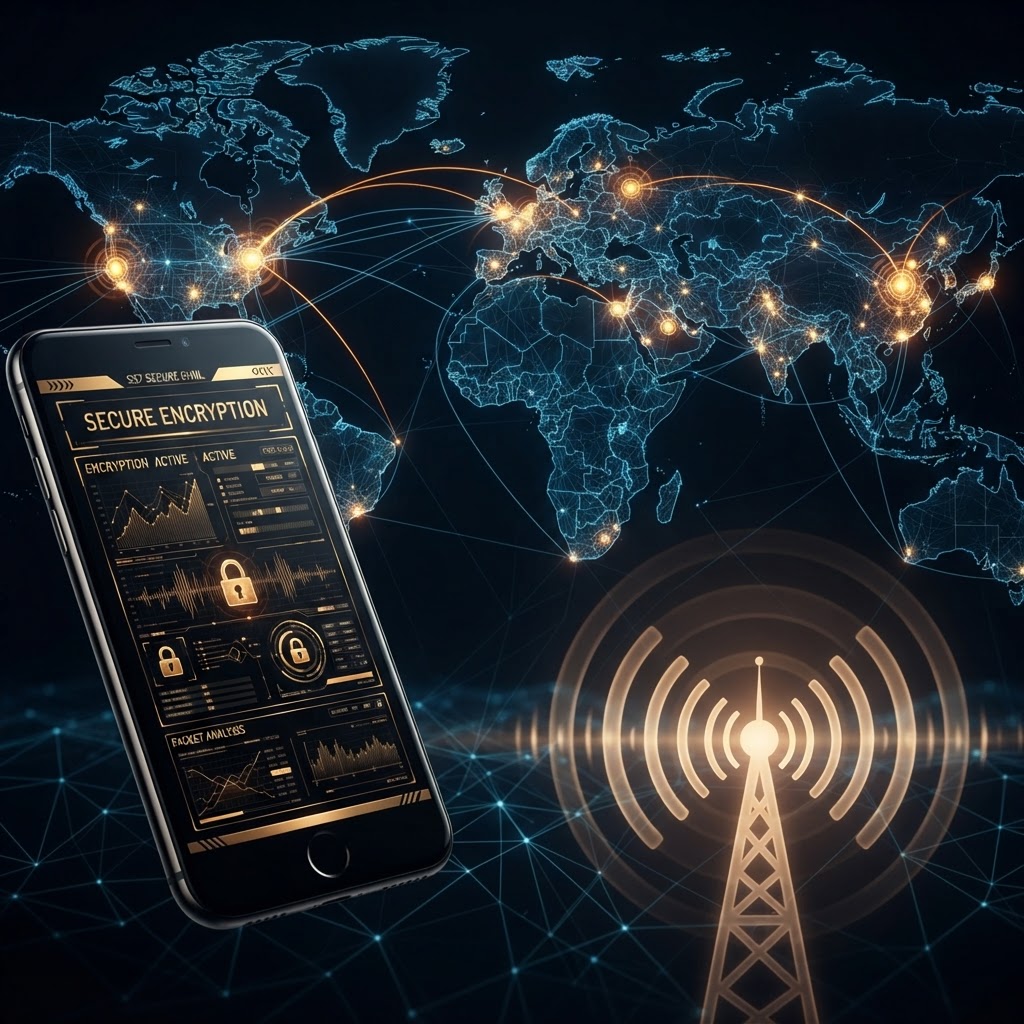
The Salt Typhoon Breach and the Collapse of Carrier Trust
Recent developments in the cybersecurity landscape have exposed a critical failure in the global telecommunications infrastructure. The most significant event in the last seven days involves the "Salt Typhoon" breach, where China-linked threat actors successfully penetrated the core networks of major United States telecommunications providers, including AT&T and Verizon. This was not a standard data breach; the adversaries gained access to the very systems used by carriers to fulfill lawful wiretap requests. This level of cellular interception represents a catastrophic compromise of the "lawful intercept" architecture, effectively turning the tools of state surveillance against the state itself.
For corporate and investigative professionals, the message is clear: the carrier layer can no longer be considered a trusted medium. When state-sponsored actors can burrow into the network plumbing to access call records and private communications, the traditional reliance on network-level security is obsolete. This breach highlights the urgent need for encrypted communications that operate independently of the carrier's infrastructure. By utilizing end-to-end encryption, data remains unreadable even if the underlying network is fully compromised. This incident has forced a pivot in advice from agencies like the FBI and CISA, who now openly advocate for the use of third-party encryption to mitigate the risks of carrier-level mobile surveillance.
SS7 Vulnerabilities: The Global Tracking Engine
Signaling System 7 (SS7) is a protocol suite developed in the 1970s that remains the backbone of global telecommunications, facilitating roaming, SMS delivery, and call routing. Its fundamental flaw is a total lack of authentication; the network inherently trusts any entity that connects to it. Recent reports from the EFF and other watchdog groups indicate that this "trust-based" model is being exploited at an industrial scale. Surveillance-for-hire firms now lease SS7 access to provide location tracking and message interception services to the highest bidder.
An SS7 exploit allows an attacker to query the network for a target's location or reroute their traffic without ever needing physical proximity to the device. This is often achieved through "Update Location" requests, which trick the network into thinking a device is roaming on a malicious switch. Once the traffic is rerouted, attackers can intercept unencrypted SMS messages—frequently used for two-factor authentication (2FA)—and even listen to voice calls. The emergence of turnkey SS7 bypass exploits on underground forums, sometimes priced as low as $5,000, demonstrates that these capabilities are no longer reserved for nation-states. To counter this, professionals are increasingly turning to hardware-modified phones and private SIM cards that decouple a user's identity from their phone number, making SS7-based queries significantly harder to execute.
IMSI Catchers and the 2G Downgrade Attack
While SS7 exploits work from across the globe, the IMSI catcher—often referred to as a "Stingray" or "Fake Base Station"—remains the primary tool for localized cellular interception. An IMSI catcher masquerades as a legitimate cell tower, forcing all mobile devices within its radius to connect to it. Once connected, the device is prompted to reveal its International Mobile Subscriber Identity (IMSI), a unique identifier tied to the SIM card.
Modern IMSI catchers utilize a "downgrade attack" to bypass the security features of 4G and 5G networks. By jamming higher-frequency bands or spoofing a 2G signal, the catcher forces the target device to use the legacy GSM (2G) protocol. Unlike modern standards, 2G does not require mutual authentication, meaning the phone cannot verify if the tower is legitimate. Furthermore, 2G encryption is either non-existent or easily cracked, allowing for the interception of voice and text in real-time. This form of hardware surveillance is becoming more accessible as software-defined radios (SDRs) and open-source baseband stacks become cheaper and more sophisticated. For those requiring a Pegasus spyware alternative or protection against such localized threats, hardened handsets running security-focused operating systems like GrapheneOS are essential, as they can be configured to disable 2G entirely and alert the user to suspicious network behavior.
The Convergence of Spyware and Network Exploits
We are currently witnessing a convergence between network-level interception and device-level compromise. Cellphone spyware and mobile malware are increasingly being delivered via zero-click exploits that leverage the vulnerabilities discussed above. For instance, an attacker might use an SS7 exploit to locate a target and then deploy an IMSI catcher to intercept the data stream and inject a malicious payload directly into the device's browser or operating system.
Once a device is infected, the scope of surveillance expands from simple metadata collection to full-spectrum monitoring, including access to the camera, microphone, and encrypted app data. This makes spyware for phones a potent threat even for those using encrypted apps, as the malware captures the data before it is encrypted or after it is decrypted on the handset. In the realm of mobile forensics, detecting these sophisticated intrusions requires specialized tools and a deep understanding of both network signaling and device baseband logging. To manage these risks, organizations are deploying C2 dashboards to monitor their fleet of secure devices, ensuring that any anomaly in network behavior or device integrity is flagged immediately.
Key Takeaway
The recent Salt Typhoon breach and the continued exploitation of SS7 and IMSI catcher vulnerabilities signal a permanent shift in the mobile security landscape. The carrier network is no longer a secure perimeter; it is a compromised environment. To maintain confidentiality, users must move security to the "edge"—the device itself. This involves adopting end-to-end encrypted communications, utilizing hardware-modified phones that can resist downgrade attacks, and treating the cellular radio as an untrusted interface. In an era of ubiquitous mobile surveillance, the only effective defense is to ensure that even if the signal is captured, the content remains an unbreakable cipher.
Note: The technologies and methods described herein are intended for lawful security auditing, compliance, and personal privacy protection only.
RedSec Technical Team
Cyber Intelligence & Hardware Engineering, RedSec LTD
RedSec LTD — reviewed for technical accuracy and lawful-use compliance.
Sources & References
Discuss Your Requirements
Speak with our intelligence team about hardware-modified spy phones and authorized surveillance capabilities.
Request a ConsultationRelated Intelligence
SS7 and IMSI Catcher Threats: The 2026 Mobile Surveillance Landscape
SpyPhone analysis of the latest SS7 and IMSI catcher developments. Learn how modern mobile surveillance exploits signaling protocols to track and intercept.
Threat IntelligenceMobile Threat Intelligence: APT Campaigns and Surveillance Trends 2026
Explore the latest mobile threat intelligence on APT campaigns, zero-click exploits, and mobile malware targeting high-profile individuals and enterprise users.