C2 Dashboard for Spy Phone Surveillance
A unified command-and-control dashboard delivering real-time remote access to 20 cyber-intelligence capabilities on hardware-modified spy phones — from message interception to ambient audio, location, and credential capture.
The Command and Control Dashboard
Your PC remotely controls the Samsung device through the C2 dashboard for remote surveillance and lawful interception. The Overview page delivers a single-screen technical fingerprint of the monitored device — everything you need to assess its state, exposure, and operational value.
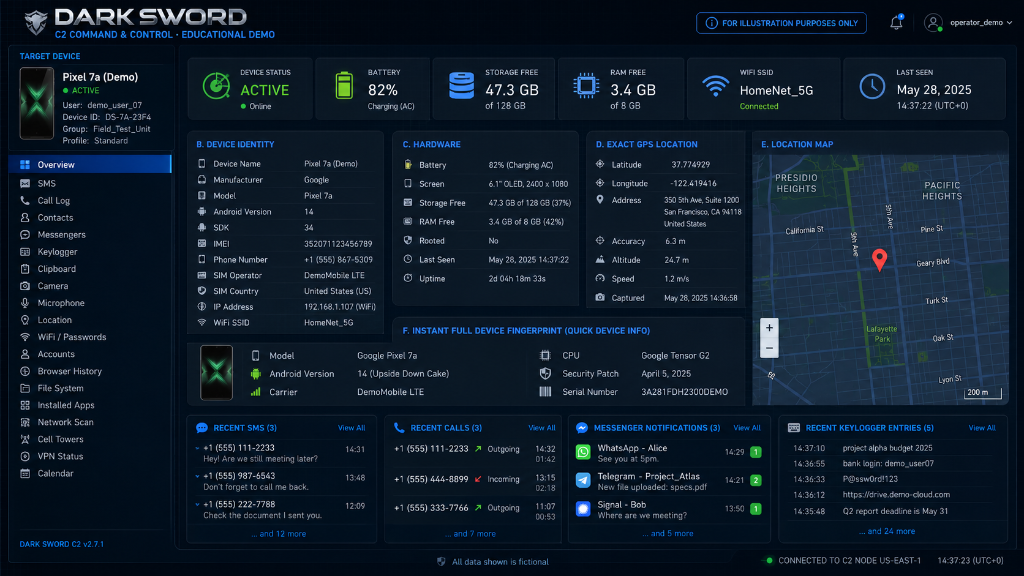
Device Telemetry Captured
Security Significance
This feature gives the operator an immediate technical fingerprint of the device. It helps identify the exact phone model, Android version, carrier, connectivity state, and whether the device is currently active.
In a threat-analysis context, this information can be used to determine the device's exposure level, possible vulnerabilities, privilege state, and operational value — all from a single consolidated view.
SMS Monitoring Page
The SMS module displays inbound and outbound messages. For each message it captures sender number, receiver number, full message content, timestamp, and direction — received or sent.
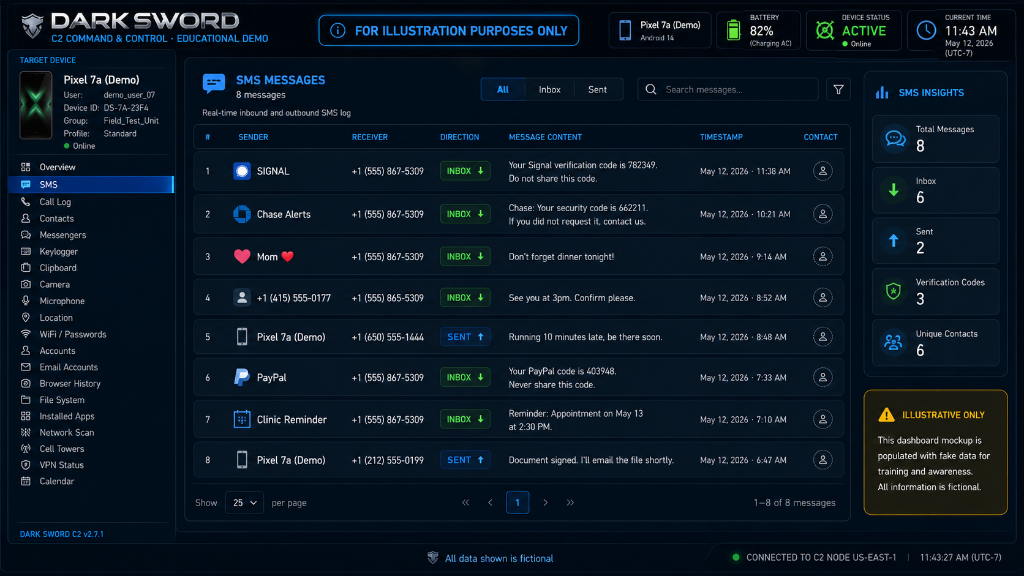
Security Significance
SMS access is highly sensitive because SMS is still widely used for one-time passwords, banking alerts, verification codes, appointment confirmations, account recovery, and private communications. Intercepting this channel provides a comprehensive view of the target's authentication activities and personal correspondence.
High-Value SMS Categories
Call Log Page
The call log module displays incoming, outgoing, missed, rejected, and unknown calls. It may include the contact name, phone number, call type, call duration, date, and exact time.
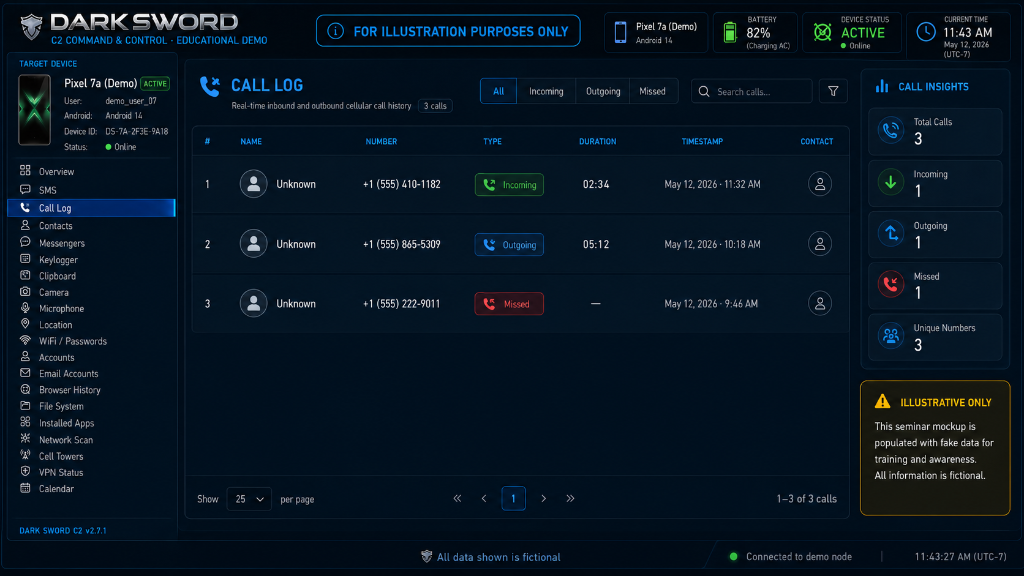
Security Significance
Call logs expose relationship patterns. Even without recording the call content, call metadata can reveal who the user communicates with, how often, and at what times. It reveals social structure, habits, and trusted relationships — including relationship mapping, business intelligence collection, and identification of lawyers, banks, doctors, family members, colleagues, and other sensitive contacts.
Intelligence Value
Contacts Page
The contacts module extracts the full phonebook — names, phone numbers, email addresses, physical addresses, birthdays, notes, contact photos, organizations, and job titles. Includes search and export functions for operational use.
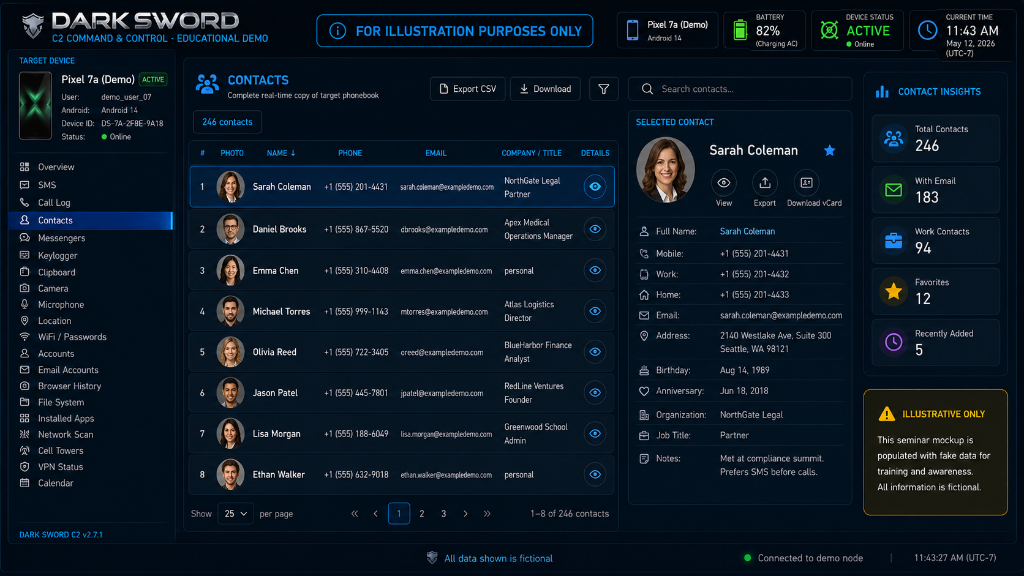
Security Significance
A full contact list gives the operator a ready-made map of the target's personal and professional network. Once the phonebook is exposed, access may expand beyond the individual device to an entire organization, family, or business network.
This feature functions as a network-intelligence tool, enabling analysis of the target's social graph, hierarchy of relationships, and points of influence.
Operational Capabilities
Messengers / Notification Monitoring Page
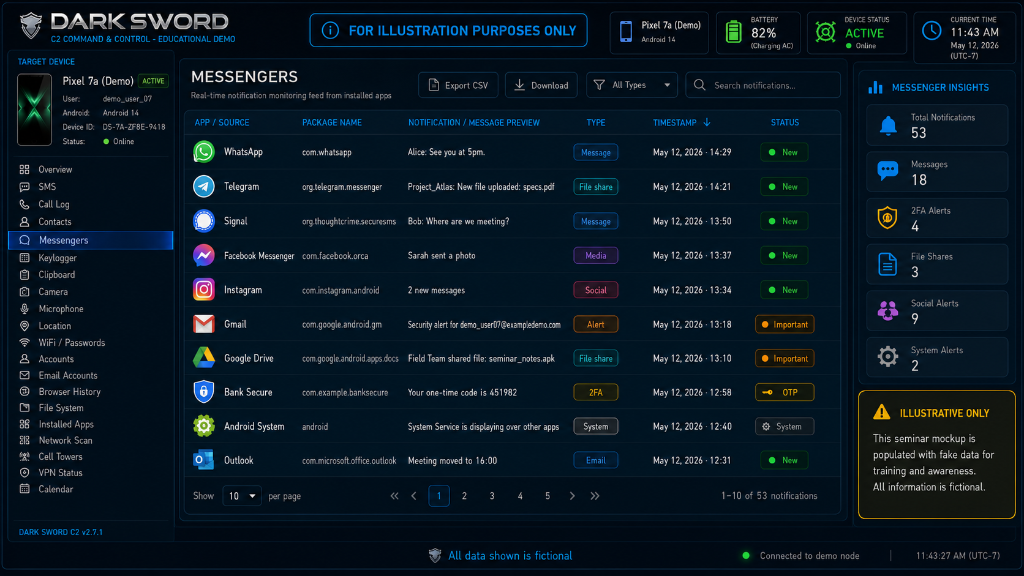
The messenger module monitors notifications from WhatsApp, Signal, Telegram, Facebook Messenger, Gmail, Google Drive, and other applications — displaying package names, notification text, message previews, timestamps, file-sharing alerts, system notifications, and push alerts.
Security Significance
Even where full encrypted chat extraction is not possible, notification content may still reveal message previews, OTP codes, sender names, banking alerts, and sensitive context.
This module provides real-time visibility into communications, capture of notification-based verification codes, monitoring of file-sharing activity, and privacy compromise across multiple apps simultaneously.
Operational Capabilities
Keylogger Page
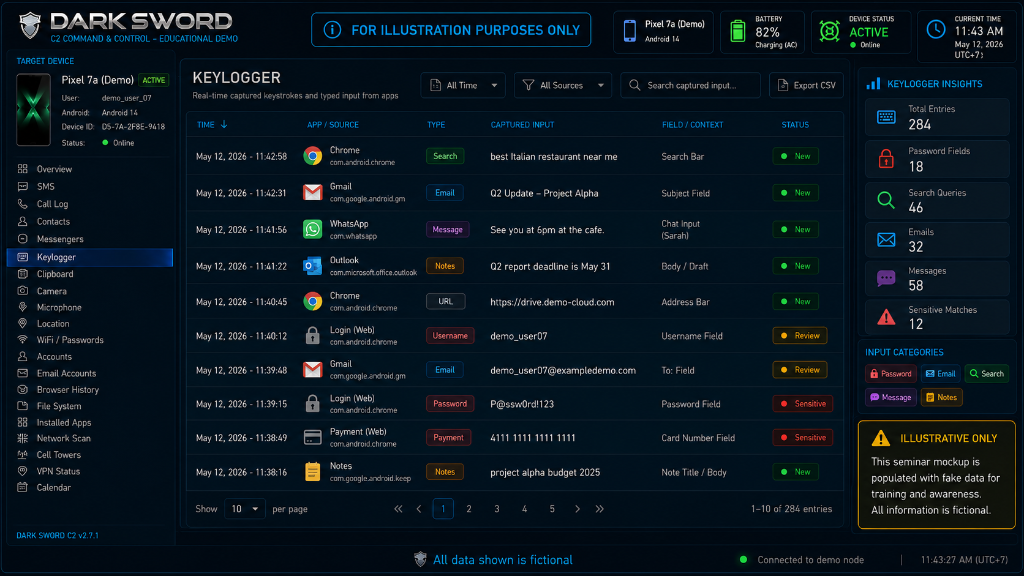
The keylogger module records typed input across apps — capturing passwords, login details, search queries, emails, credit card numbers, and other text entered into the device.
Security Significance
A keylogger turns the phone into a credential-harvesting device. It can defeat many security controls because it captures secrets at the exact moment the user enters them — bypassing encryption, password managers, and two-factor authentication alike.
This module enables monitoring of potential theft of passwords, banking credentials, crypto wallet data, business logins, private messages, search queries, and personal information.
Captured Data Categories
Clipboard Monitoring Page
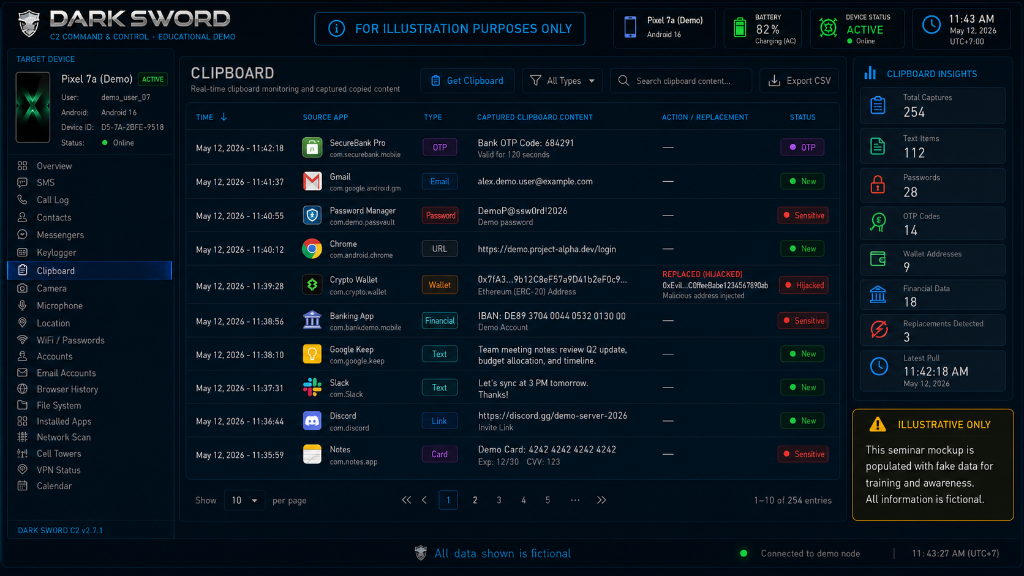
The clipboard module reads copied content and may also replace it. It captures passwords, links, crypto addresses, OTP codes, bank details, IBANs, credit card data, private messages, and copied images or text.
Security Significance
The clipboard is often used as a temporary bridge between apps. Users copy passwords, crypto addresses, bank details, verification codes, and private content without realizing that the clipboard can be monitored — or actively manipulated.
This module enables monitoring of credential theft, OTP theft, crypto address replacement, payment redirection, data manipulation, and account compromise — all triggered silently by a simple copy action.
Risk Categories
Camera Page
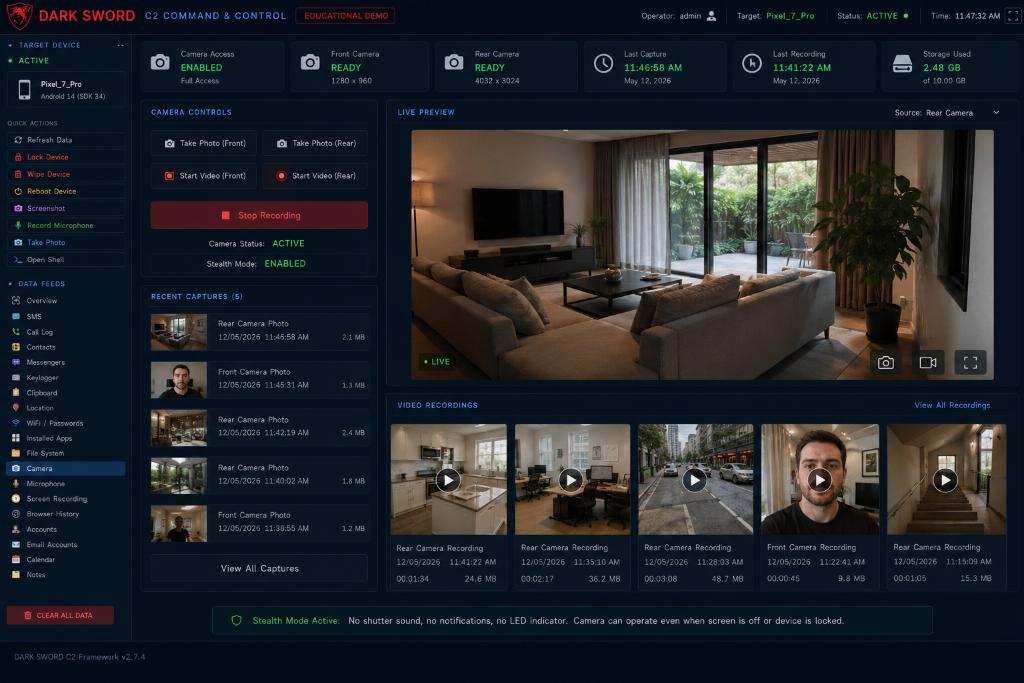
The camera module allows remote use of the front camera, rear camera, or both — taking photos, starting or stopping video recording, uploading captured media to the dashboard, previewing content, and downloading files.
Security Significance
Camera access converts the smartphone into a visual surveillance sensor — enabling capture of sensitive documents, observation of people nearby, exposure of the user's home or office, and collection of compromising images or videos.
This feature illustrates the physical-world connection: the device is not only a data container — it is also a camera, microphone, GPS tracker, and network sensor operating silently in the target's environment.
Surveillance Capabilities
Microphone Page
The microphone module supports remote audio recording, including room audio and possibly voice-call audio. The dashboard displays date/time, duration, file size, filename, audio preview, and download options such as MP3 or MP4.
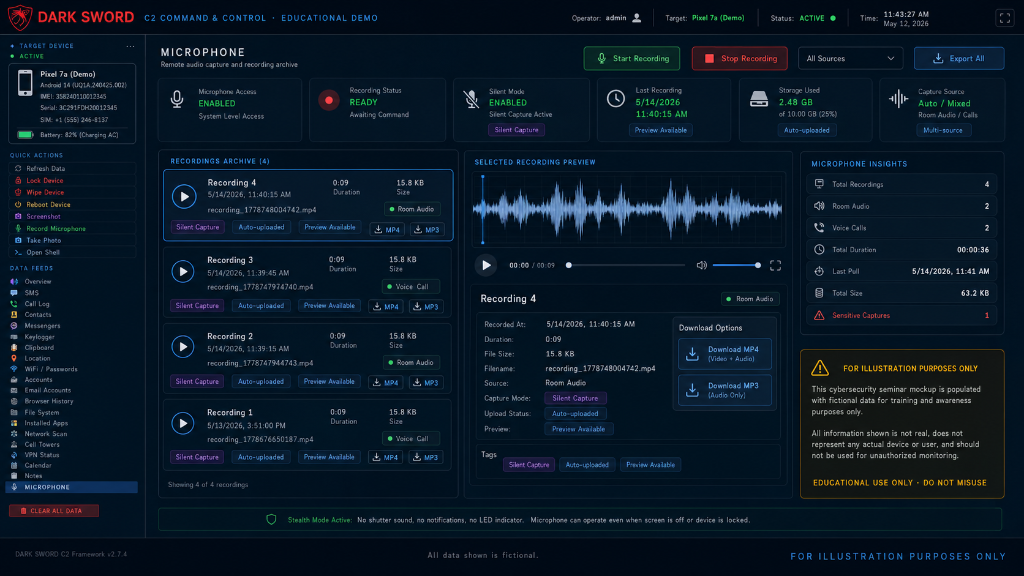
Security Significance
Microphone access enables covert collection of conversations near the phone — exposing meetings, private conversations, business negotiations, legal discussions, medical conversations, family conversations, and calls.
For executive, government, legal, and corporate environments, microphone compromise is one of the most serious capabilities — the phone becomes a live intelligence-collection device operating silently inside any room.
High-Risk Environments
Location / GPS Page
The location module displays latitude, longitude, address, accuracy, altitude, speed, map view, and location history — including live updates, historical tracking, and geofencing-style alerts.
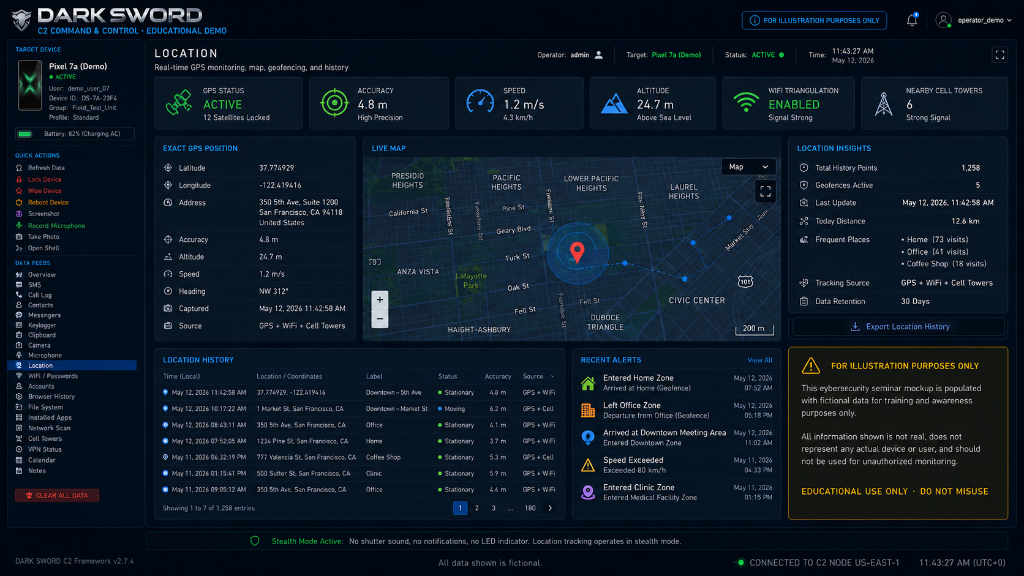
Security Significance
Location tracking connects digital compromise to physical surveillance — enabling stalking, exposure of home and work addresses, identification of routines, tracking of family locations, monitoring of travel, and timing of physical or cyber operations.
Location data is not just a map coordinate. Over time, it becomes a behavioral profile: where the person sleeps, works, meets others, travels, and spends private time.
Intelligence Value
WiFi / Passwords Page
The WiFi module lists saved WiFi networks and may expose WiFi passwords. It also shows nearby networks with SSID, BSSID, signal strength, and security type.
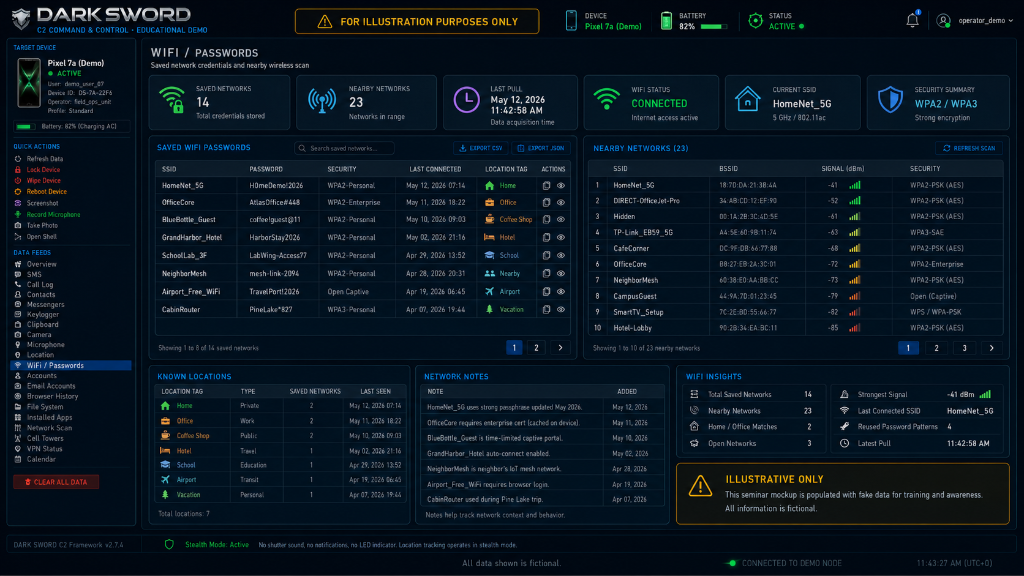
Security Significance
WiFi data connects the phone to the user's physical locations and networks. Saved WiFi names may reveal home, office, hotels, airports, schools, and other places the user has visited.
This includes exposure of home or office network credentials, mapping of user movement, possible lateral movement into local networks, and password-reuse attacks against other accounts and services.
Attack Vectors
Accounts Page
The accounts module lists accounts configured on the Android device — including Google/Gmail, Outlook, Yahoo, corporate Exchange, manufacturer accounts, social media, messaging apps, work accounts, school accounts, banking/finance apps, and other apps integrated with Android account management.
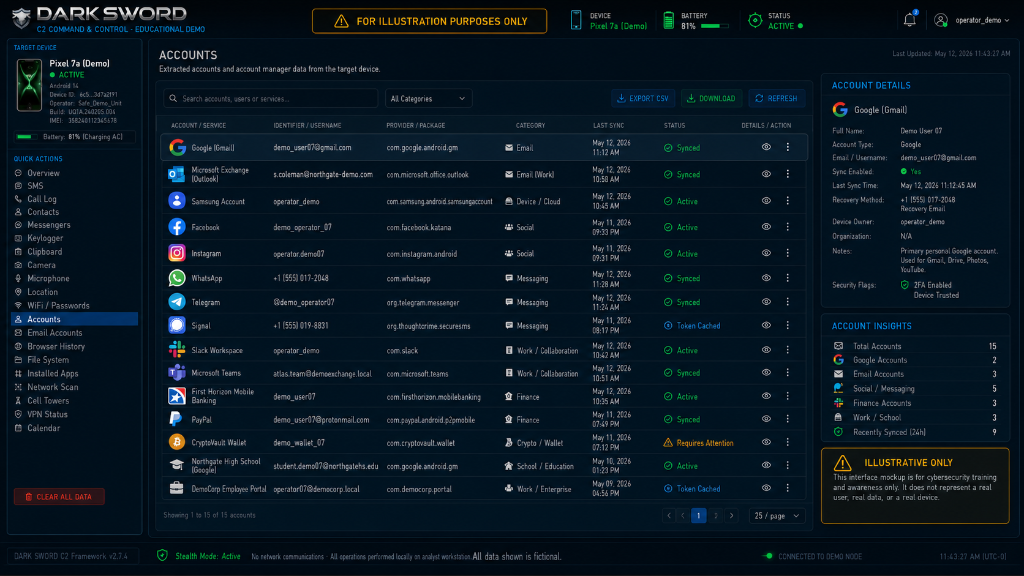
Security Significance
Even without passwords, knowing which accounts exist on a device is valuable intelligence. It allows attackers to tailor phishing messages and account-recovery attacks with precise targeting.
This module enables targeted phishing, password reset attacks, account takeover attempts, impersonation, and identity mapping — all derived from a simple list of registered accounts.
Operational Capabilities
Email Accounts Page
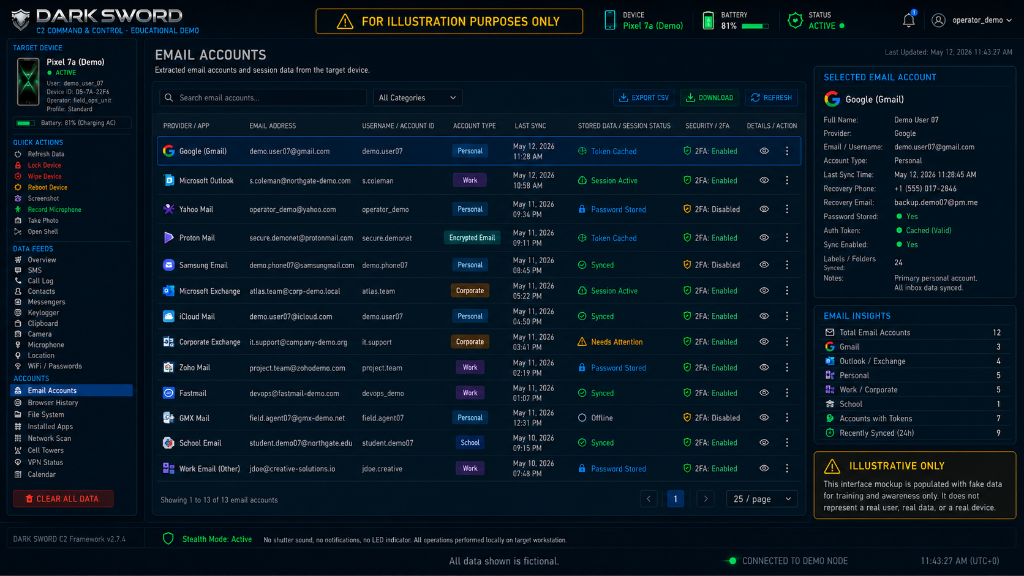
The email accounts module displays configured email addresses, provider type, username, last sync time, and possibly authentication-related data if accessible.
Security Significance
Email accounts are often the central recovery mechanism for banking, social media, cloud storage, crypto exchanges, business platforms, and identity services.
Email compromise can become a master key. Once email is compromised, many other services can be reset or accessed — enabling takeover of linked accounts, business email compromise, exposure of corporate communications, and identity fraud.
Attack Vectors
Browser History Page
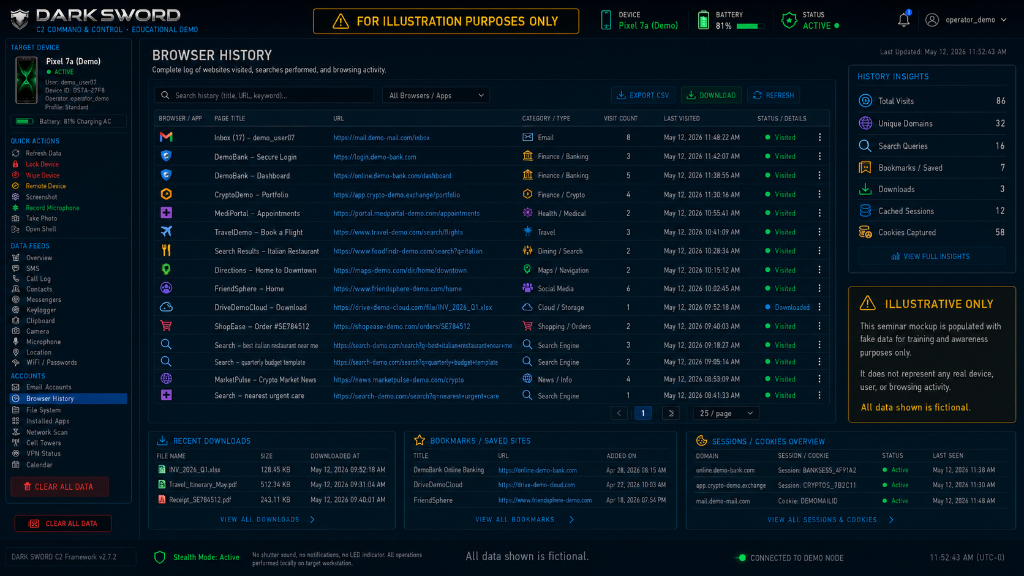
The browser history module displays visited websites, page titles, timestamps, visit counts, search queries, downloads, bookmarks, cookies, cached sessions, form data, and other browser artifacts.
Security Significance
Browser data reveals interests, intentions, sensitive services, financial activity, medical searches, private behavior, and possible logged-in sessions — including profiling, blackmail leverage, and identification of crypto or banking platforms.
Browser artifacts can reveal both technical and personal intelligence. They help attackers understand what the user values, fears, uses, and trusts — turning browsing history into an actionable intelligence dossier.
Intelligence Value
Screen Time / App Usage Page
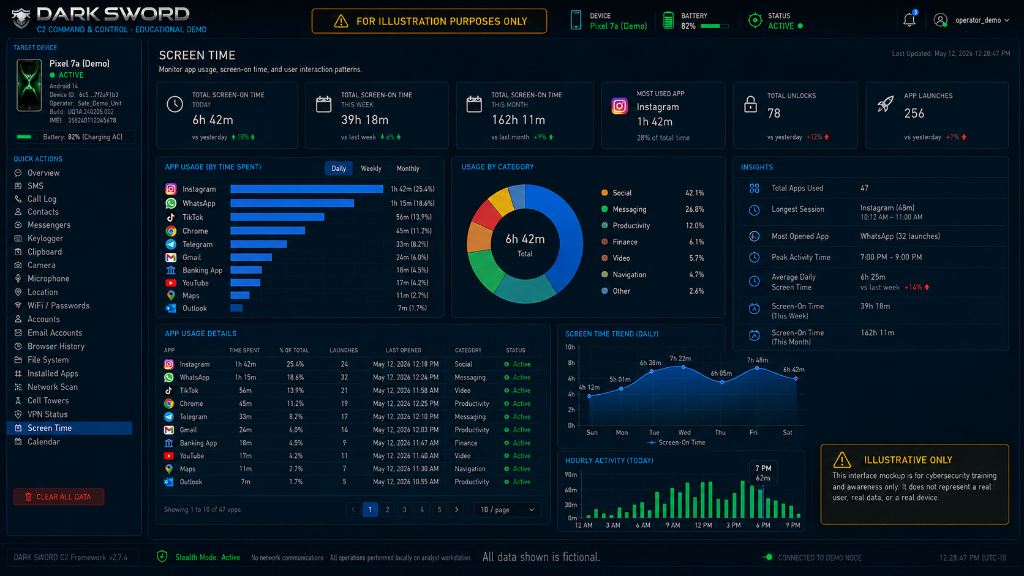
The screen time module displays total screen-on time, app usage duration, number of app launches, daily/weekly/monthly charts, and a list of apps opened by the user.
Security Significance
App usage data creates a detailed behavioral profile of the user — revealing which banking apps, crypto wallets, dating apps, work tools, password managers, and 2FA apps they rely on daily.
Knowing which apps a user opens most often helps an attacker choose the best social-engineering theme or timing — turning screen time data into a precision targeting tool for phishing, impersonation, and account takeover.
Profiling Capabilities
File System Page
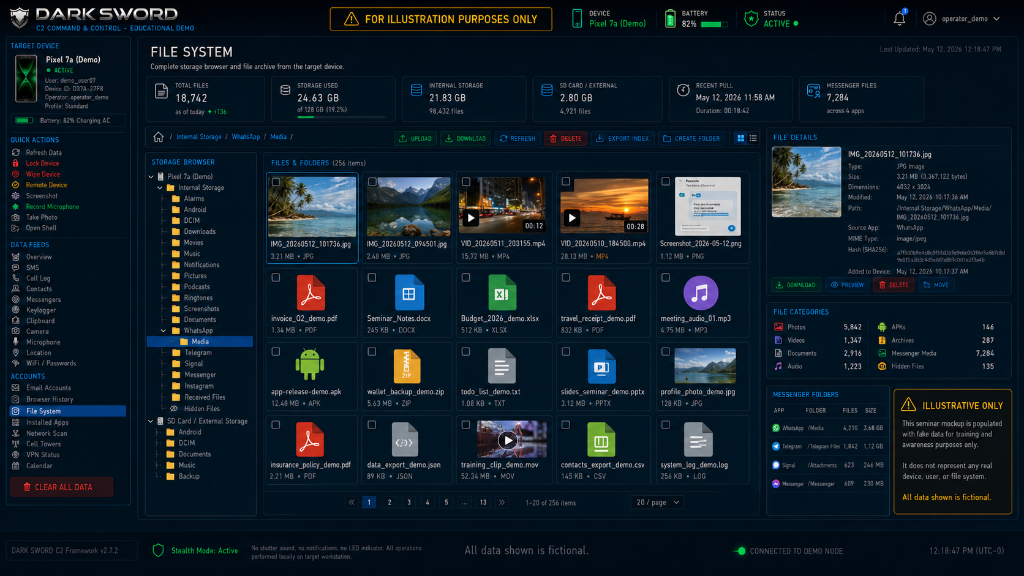
The file system module provides access to device storage — displaying photos, videos, audio recordings, documents, downloads, screenshots, APK files, hidden files, system files, and messenger media folders such as WhatsApp, Telegram, Signal, Facebook Messenger, and Instagram.
Security Significance
File access is one of the most powerful capabilities — exposing private media, business files, identity documents, contracts, invoices, wallet files, and received attachments. It enables data theft, extortion, intellectual property theft, and tampering with files remotely.
This module represents the difference between "monitoring" and full remote data control — giving operators the ability to browse, download, and interact with the entire device storage as if physically holding the device.
Operational Capabilities
Installed Apps Page
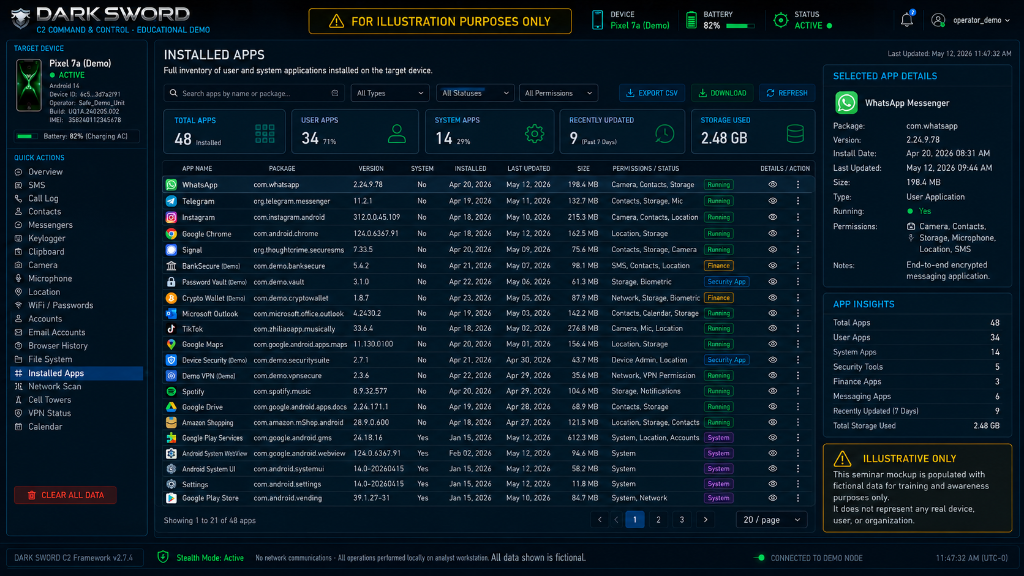
The installed apps module lists user-installed and system apps — including app name, package name, version, install date, last update date, app size, permissions, and running status.
Security Significance
Installed app inventory provides reconnaissance about the user's habits, financial services, security tools, work platforms, and possible defensive software — enabling target selection, security evasion, and tailored phishing campaigns.
An app list is a personal and professional fingerprint. It reveals what kind of person or organization the device belongs to and which attack path may be most effective — from banking apps and crypto wallets to 2FA authenticators and corporate tools.
Intelligence Value
Network Scan Page
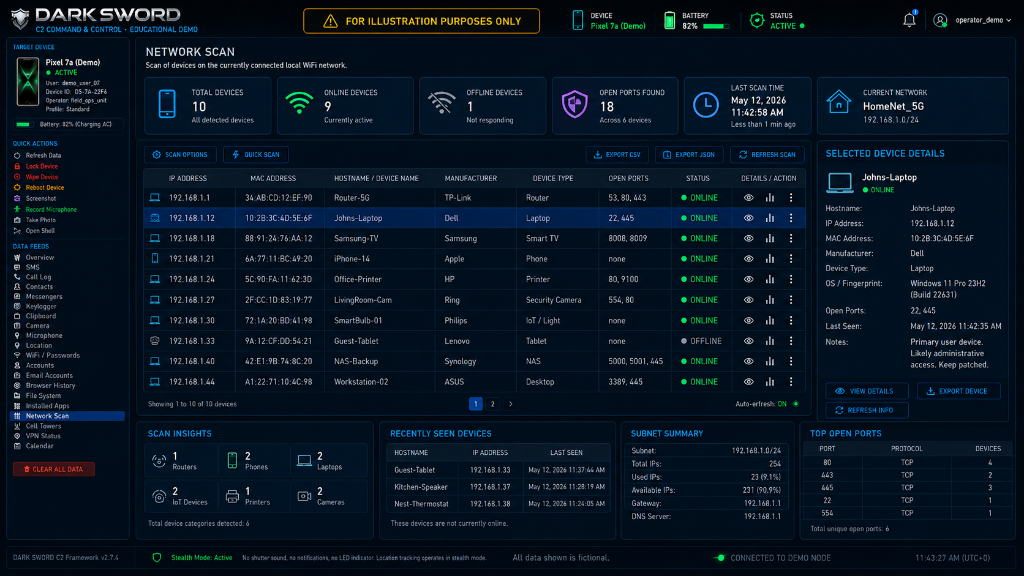
The network scan module scans the local WiFi network to which the phone is connected — displaying IP addresses, MAC addresses, hostnames, manufacturers, device types, online/offline status, and open ports.
Security Significance
The phone becomes a reconnaissance point inside the local network — enabling mapping of home or office devices, identification of laptops, smart TVs, cameras, printers, routers, and IoT devices, and preparation for lateral movement attacks.
The mobile phone should not be treated as isolated — it can become a bridge into the internal network environment, exposing infrastructure that is otherwise air-gapped from the internet.
Operational Capabilities
Cell Towers Page
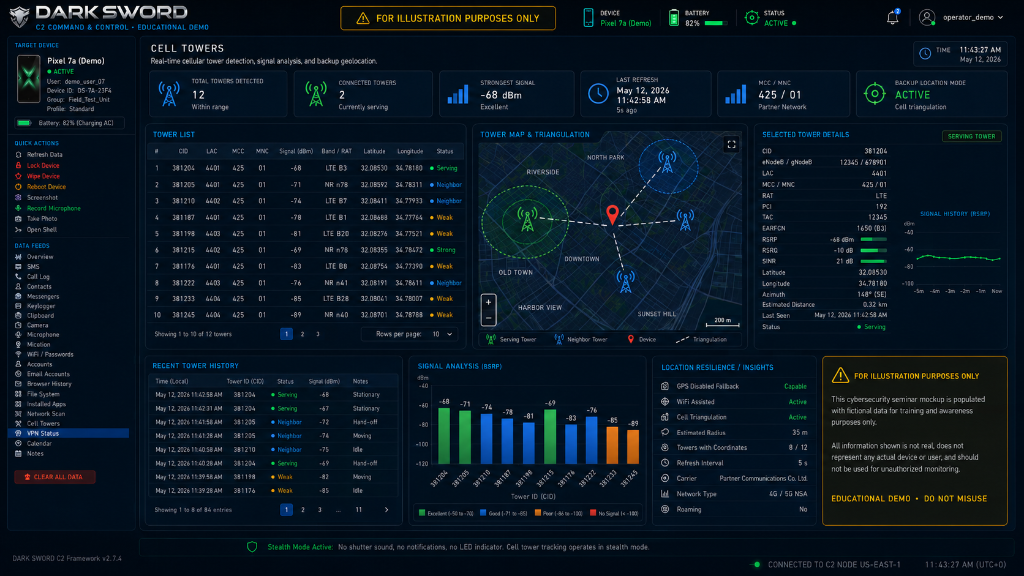
The cell towers module displays nearby and connected cellular towers — including Cell ID, Location Area Code, Mobile Country Code, Mobile Network Code, signal strength, tower coordinates, real-time updates, and a map display.
Security Significance
Cell tower data supports location tracking even where GPS is weak, unavailable, disabled, or unreliable — providing backup geolocation, movement analysis, and correlation with other signals.
Location tracking is strongest when multiple signals are combined: GPS, WiFi, cell tower metadata, IP address, and movement speed. Together they form a near-continuous, high-confidence position record.
Operational Capabilities
VPN Status Page
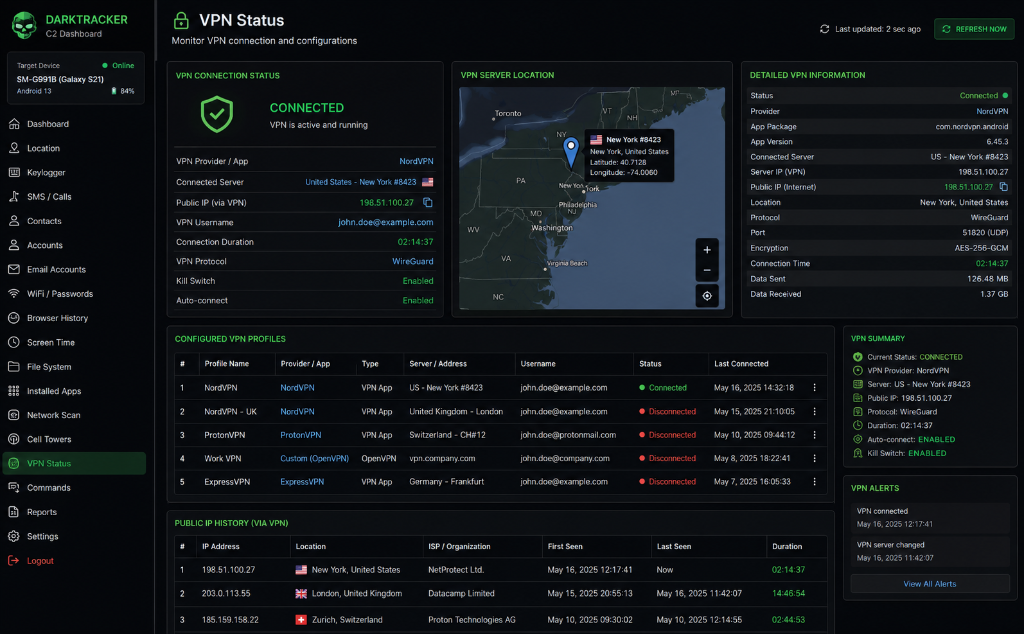
The VPN module displays connection status, provider or app name, connected server, public IP address, username, connection duration, VPN protocol, and all configured VPN profiles on the device.
Security Significance
VPN information reveals whether the user is attempting to mask their network location or route traffic through a privacy service — exposing the VPN provider, server location, public IP, account credentials, and configuration for potential targeting.
VPNs protect network traffic in transit, but endpoint compromise can still expose local data, credentials, screenshots, keystrokes, and sensor output — rendering the VPN's privacy guarantees irrelevant.
Operational Capabilities
Calendar Page
The calendar module extracts events from Google Calendar, Samsung Calendar, Outlook, Exchange, and other synced calendars — including title, date, start and end time, location, description, notes, attendees, recurring events, and reminders.
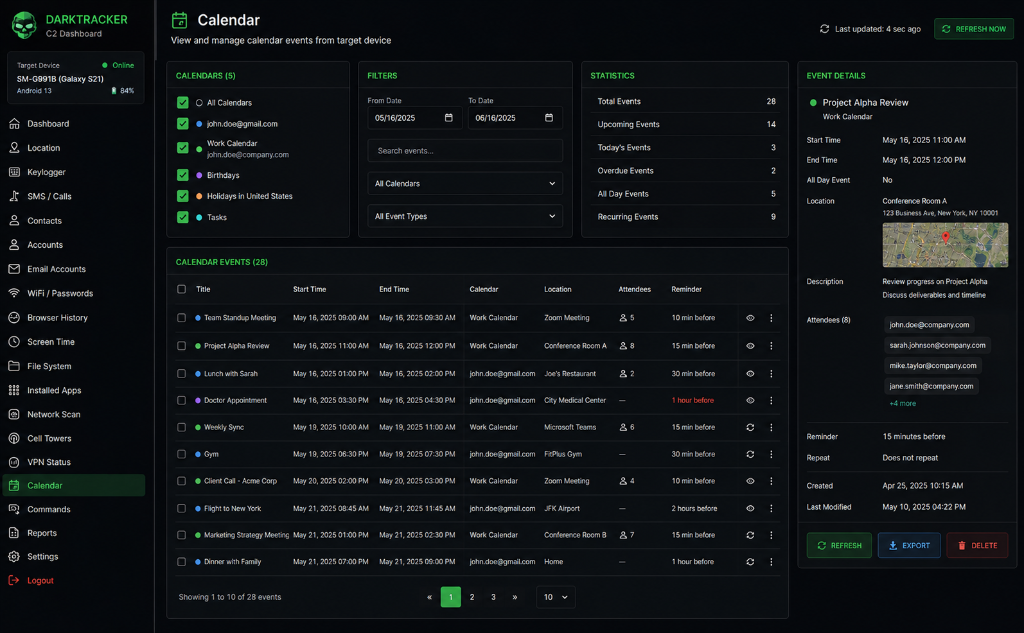
Security Significance
Calendar access exposes the user's full schedule — meetings, travel, appointments, deadlines, and personal or professional commitments. This enables physical stalking, timed phishing attacks, business intelligence gathering, and targeted intrusion planning.
Calendar data is operational intelligence. It tells an attacker where the person will be, when they are busy, who they are meeting, and what topics may be sensitive — making it one of the most strategically valuable data sources on a device.
Operational Capabilities
C2 Data Flow Schematic
Illustrative architecture only — no live data, device identifiers, or operational details are shown. This diagram depicts how intelligence moves from the hardware implant to the operator's C2 dashboard over a protected channel.
Target Device
Samsung Galaxy flagship
Looks & behaves as a normal smartphone to the user.
Hardware Implant
Beneath the Android OS
Dedicated chipset — no OS process, file, or socket.
Encrypted Channel
Out-of-band transport
Hardware-bound session keys; mutual authentication.
C2 Dashboard
Operator interface
20 capabilities on one authenticated session.
Diagram is a sanitized representation. Actual C2 interfaces, device identifiers, and operational telemetry are withheld for operator and client security.
Deploy a C2 Dashboard
Access the full command-and-control interface with 20 remote surveillance capabilities on a hardware-modified Samsung Galaxy spy phone.
Request a ConsultationZero-Click Hardware Capabilities
A tabbed breakdown of the surveillance chipset's architecture, capabilities, persistence, and security. Sanitized specification — proprietary identifiers and firmware versions are withheld for operational security.
The surveillance layer is a dedicated cyber-intelligence coprocessor embedded on the device mainboard, physically and logically beneath the Android operating system.
Zero-Click spyware models, side-by-side
Hardware capabilities contrasted across our three deployment tiers — choose the platform matched to your authorized operational requirements.
| Capability | SpyPhone ReconField Triage | RecommendedSpyPhone TacticalOperational | SpyPhone CommandFlagship |
|---|---|---|---|
| Hardware Foundation | |||
| Base handset | Samsung Galaxy mid-range | Samsung Galaxy S-series flagship | Samsung Galaxy S26 Ultra |
| Embedded surveillance chipset | Compact module | Dedicated cyber-intelligence chipset | Enhanced dual-core chipset |
| Intelligence storage partition | Isolated, encrypted | Isolated, encrypted | Hardware-isolated secure enclave |
| Persistence & Survivability | |||
| Survives factory reset | Yes | Yes | Yes |
| Survives OS updates | Yes | Yes | Yes |
| Active in airplane mode | Limited (store-and-forward) | Yes | Yes |
| Anti-forensic wipe | Optional | Standard | |
| Command & Control | |||
| Out-of-band C2 channel | Yes | Yes | Yes |
| Hardware-isolated operator comms | Yes | Yes (encrypted) | |
| Audit-logged commands | Yes | Yes (evidentiary) | |
| Surveillance Vectors | |||
| Active capability count | 12 vectors | 20 vectors | 20 vectors + integrity monitoring |
| Ambient microphone activation | Yes | Yes | Yes |
| Remote camera capture | Yes | Yes | |
| Keylogger & clipboard capture | Yes | Yes | Yes |
| GPS + cell-tower triangulation | GPS only | Yes | Yes |
| Delivery & Procurement | |||
| Encrypted courier delivery | Standard | Insured FedEx | Insured FedEx + tamper-evident |
| License model | Annual | Monthly / 6-mo / Annual | Annual + support retainer |
Entry hardware-modified platform for source-device triage and lightweight monitoring.
- Base handset
- Samsung Galaxy mid-range
- Embedded surveillance chipset
- Compact module
- Intelligence storage partition
- Isolated, encrypted
- Survives factory reset
- Yes
- Survives OS updates
- Yes
- Active in airplane mode
- Limited (store-and-forward)
- Anti-forensic wipe
- Out-of-band C2 channel
- Yes
- Hardware-isolated operator comms
- Audit-logged commands
- Active capability count
- 12 vectors
- Ambient microphone activation
- Yes
- Remote camera capture
- Keylogger & clipboard capture
- Yes
- GPS + cell-tower triangulation
- GPS only
- Encrypted courier delivery
- Standard
- License model
- Annual
Full 20-vector persistent layer for close-protection and corporate security deployments.
- Base handset
- Samsung Galaxy S-series flagship
- Embedded surveillance chipset
- Dedicated cyber-intelligence chipset
- Intelligence storage partition
- Isolated, encrypted
- Survives factory reset
- Yes
- Survives OS updates
- Yes
- Active in airplane mode
- Yes
- Anti-forensic wipe
- Optional
- Out-of-band C2 channel
- Yes
- Hardware-isolated operator comms
- Yes
- Audit-logged commands
- Yes
- Active capability count
- 20 vectors
- Ambient microphone activation
- Yes
- Remote camera capture
- Yes
- Keylogger & clipboard capture
- Yes
- GPS + cell-tower triangulation
- Yes
- Encrypted courier delivery
- Insured FedEx
- License model
- Monthly / 6-mo / Annual
Maximum-grade chipset with secure enclave and anti-forensic decommissioning.
- Base handset
- Samsung Galaxy S26 Ultra
- Embedded surveillance chipset
- Enhanced dual-core chipset
- Intelligence storage partition
- Hardware-isolated secure enclave
- Survives factory reset
- Yes
- Survives OS updates
- Yes
- Active in airplane mode
- Yes
- Anti-forensic wipe
- Standard
- Out-of-band C2 channel
- Yes
- Hardware-isolated operator comms
- Yes (encrypted)
- Audit-logged commands
- Yes (evidentiary)
- Active capability count
- 20 vectors + integrity monitoring
- Ambient microphone activation
- Yes
- Remote camera capture
- Yes
- Keylogger & clipboard capture
- Yes
- GPS + cell-tower triangulation
- Yes
- Encrypted courier delivery
- Insured FedEx + tamper-evident
- License model
- Annual + support retainer
Download the C2 Dashboard Presentation
A high-resolution PowerPoint deck of every C2 capability — each screenshot paired with its description on the following slide. Ready for briefings and offline review.
For illustration purposes only · Educational demonstration
Authorized Use Only — Lawful Monitoring Required
SpyPhone hardware-modified devices are sold exclusively to vetted corporate, investigative, and compliance professionals for lawful monitoring of devices the purchaser is legally authorized to monitor. Use requires legal authority under the applicable jurisdiction. We do not sell for stalking, unlawful interception, or surveillance without consent where required by law. Every request is reviewed before procurement, and all sales are conditional on acceptance of our Legal Notice.