The Rise of SIM-Driven Modem Takeovers
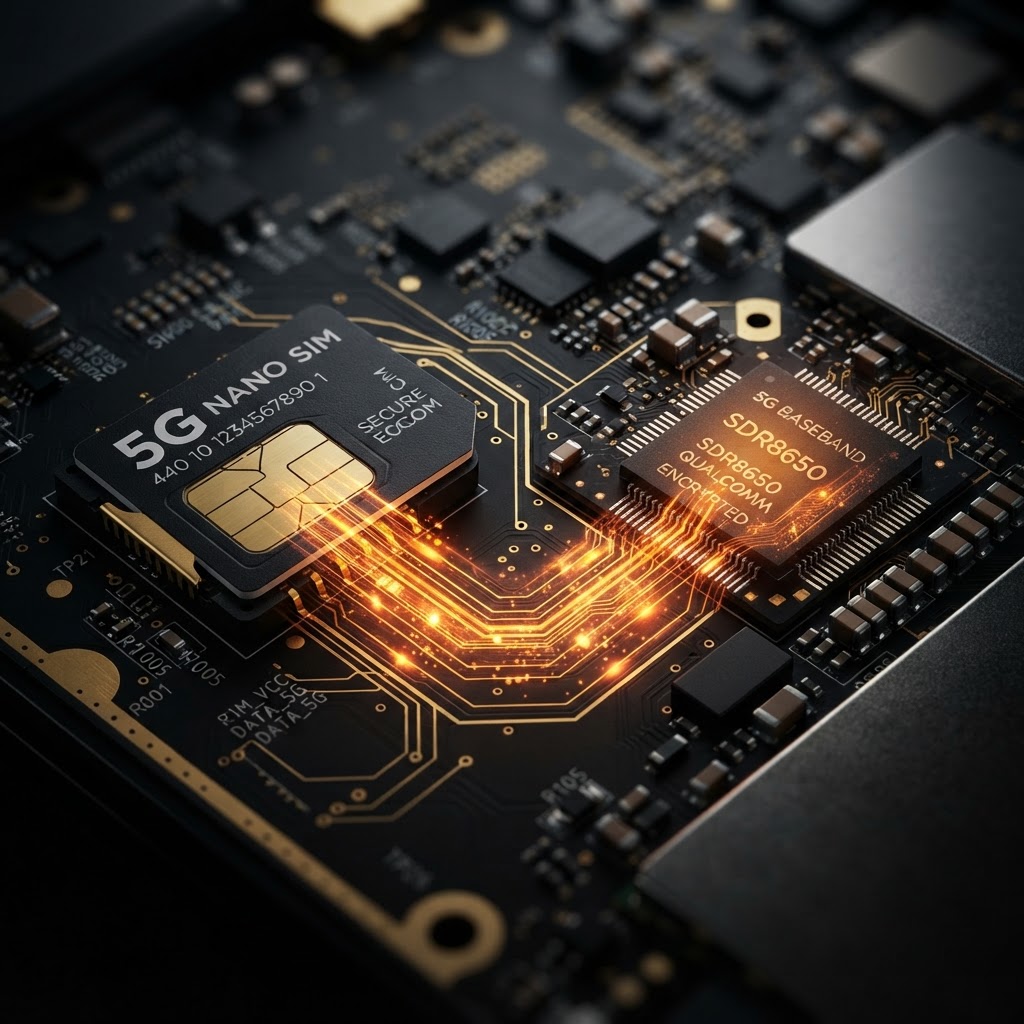
Baseband processors remain the most critical, yet least transparent, component of mobile security architecture in late 2024. Recent findings presented at the USENIX WOOT conference and Black Hat USA in August 2024 have shifted the industry's focus from remote network attacks to threats originating from the SIM card itself. Researchers have demonstrated a critical flaw in the decades-old Proactive SIM standard, which allows a SIM card to bypass the host operating system (Android or iOS) and issue raw AT commands directly to the device’s cellular modem.
AT commands (Attention commands) are the legacy instruction set used to communicate with modems. The vulnerability—highlighted in recent disclosures—reveals that many modern chipsets, particularly those from Qualcomm and MediaTek, execute these commands unconditionally. This lack of verification creates a direct path for hardware surveillance. A compromised SIM card—whether subverted via a supply chain attack, physical interposer, or remote carrier-level re-flashing—can independently read sensitive device files, intercept encrypted communications metadata, and even force a 4G-to-2G downgrade.
For corporate and investigative professionals, this discovery highlights a significant blind spot. Because the attack occurs at the hardware interface between the SIM and the baseband, it leaves zero traces in traditional system logs or mobile security apps. Detecting this level of compromise requires specialized mobile forensics equipment capable of monitoring the physical serial interface between the subscriber identity module and the radio chip. This is not merely a theoretical risk; it represents a viable method for deploying spyware for phones that operates entirely outside the user's visibility.
5G Core Logic Flaws: AI-Driven Exploitation of Subscriber Data
While hardware-level SIM exploits target the device locally, new research from Nanyang Technological University (NTU) published in mid-August 2024 has exposed systemic vulnerabilities in the 5G core network logic. Using an AI-driven testing framework, researchers identified over 80 previously unknown security flaws. The most severe vulnerabilities allow an attacker to take over a legitimate subscriber's data session by exploiting "bad assumptions" in how 5G core components handle forwarding rule IDs.
In a 5G environment, the network separates the control plane (which handles signaling) from the user plane (which handles data). The NTU research found that if an attacker can reach internal network links—often exposed due to cloud misconfigurations or compromised edge nodes—they can inject instructions that reuse a victim’s forwarding ID but with a higher priority. The network, trusting its internal logic, begins routing the victim’s outbound traffic directly to the attacker. This represents a sophisticated form of cellular interception that bypasses the enhanced encryption standards originally promised by 5G Standalone (SA) architectures.
This shift toward AI-discovered vulnerabilities suggests that traditional cellphone spyware is evolving. Attackers no longer need to rely on the user clicking a malicious link; they can now manipulate the underlying fabric of the cellular network to intercept traffic at the source. Organizations requiring high-assurance privacy are increasingly looking for a Pegasus spyware alternative that focuses on network-layer obfuscation rather than just application-layer encryption. The ability to perform zero-click interception at the carrier level renders many standard security protocols obsolete.
The Persistence of the 2G Downgrade Trap
Despite the global rollout of 5G, the legacy 2G protocol remains a primary vector for mobile surveillance. Recent research confirms that baseband vulnerabilities are frequently used to trigger a "downgrade attack." By forcing a device to communicate over 2G, attackers can exploit the protocol's lack of mutual authentication, allowing them to deploy IMSI catchers (commonly known as Stingrays) to intercept calls and SMS messages.
In response to these persistent threats, the release of Android 15 and upcoming security patches in late 2024 have introduced new hardware-level controls. For the first time, users can enforce a "Radio Lockdown" mode that physically disables the 2G radio at the firmware level, preventing the baseband from even acknowledging 2G signals from a nearby base station. This is a critical development for professionals using hardware-modified phones, as it moves the defense from software-based toggles to verifiable hardware states.
However, these defenses are only as strong as the baseband's implementation. The research showed that even with software protections, a compromised modem can still be manipulated via the SIM's Proactive commands to override these settings. This creates a recursive security problem: if the "trust anchor" (the baseband) is compromised, no amount of operating system security can guarantee privacy. This is why centralized management through a C2 dashboard for fleet-wide mobile security policy is becoming a requirement for compliance in high-risk sectors. Without a way to verify the integrity of the radio stack, encrypted phones remain vulnerable to lower-layer manipulation.
Forensics and the Visibility Gap: Why Baseband Malware Evades Detection
Baseband processors are essentially "black boxes" within the smartphone. They run their own proprietary Real-Time Operating Systems (RTOS), such as Qualcomm's QuRT or MediaTek's Nucleus, which are almost entirely opaque to researchers and end-users. This opacity is a gift to creators of mobile malware and cellphone spyware. A baseband-level implant can persist even after a full factory reset of the main phone operating system, as the baseband firmware is rarely wiped during a standard reset.
The technical difficulty of mobile forensics in this area cannot be overstated. Analyzing a potentially compromised baseband requires reverse-engineering complex binary firmware and using specialized debugging interfaces that are often disabled by manufacturers. The latest 2024 research indicates that baseband stacks are increasingly targets for zero-click Remote Code Execution (RCE). Because these chips handle complex, unauthenticated radio signals from the outside world, a single memory corruption bug in the radio interface layer can lead to full device compromise without any user interaction.
To mitigate these risks, security-conscious organizations must adopt a defense-in-depth strategy. This includes using devices with minimal baseband attack surfaces, employing network-level monitoring to detect anomalous signaling patterns, and ensuring that all encrypted communications occur over data channels that are secondary to the cellular voice/SMS layer. The era of trusting the modem by default has ended; the baseband must now be treated as a potentially hostile gateway that requires constant, rigorous verification.
Key Takeaway
The cellular security landscape in late 2024 is defined by a move toward the "invisible" layers of the mobile stack. Vulnerabilities in the Proactive SIM standard and 5G core logic prove that the baseband is the new frontline for mobile surveillance. Security professionals must prioritize hardware-level protections and network-layer forensics to defend against these sophisticated, zero-click threats that operate beneath the visibility of traditional mobile security tools. Relying solely on application-layer encryption is no longer sufficient when the underlying hardware can be subverted.
This analysis is intended for professionals in the cybersecurity, legal, and compliance sectors to understand emerging cellular threats and is not intended to facilitate any unauthorized access to private communications.
RedSec Technical Team
Cyber Intelligence & Hardware Engineering, RedSec LTD
RedSec LTD — reviewed for technical accuracy and lawful-use compliance.
Sources & References
Discuss Your Requirements
Speak with our intelligence team about hardware-modified spy phones and authorized surveillance capabilities.
Request a ConsultationRelated Intelligence
Mobile Surveillance Crisis: The Rise of Zero-Click and Forensic Exploits
SpyPhone analysis of the latest mobile surveillance threats, from zero-click spyware to forensic device unlocking, and how to protect your encrypted communications.
Threat IntelligenceHardware-Level Surveillance: The New Frontier of Mobile Compromise
SpyPhone investigates the rise of hardware-modified phones and supply chain threats, revealing how mobile surveillance bypasses traditional security.