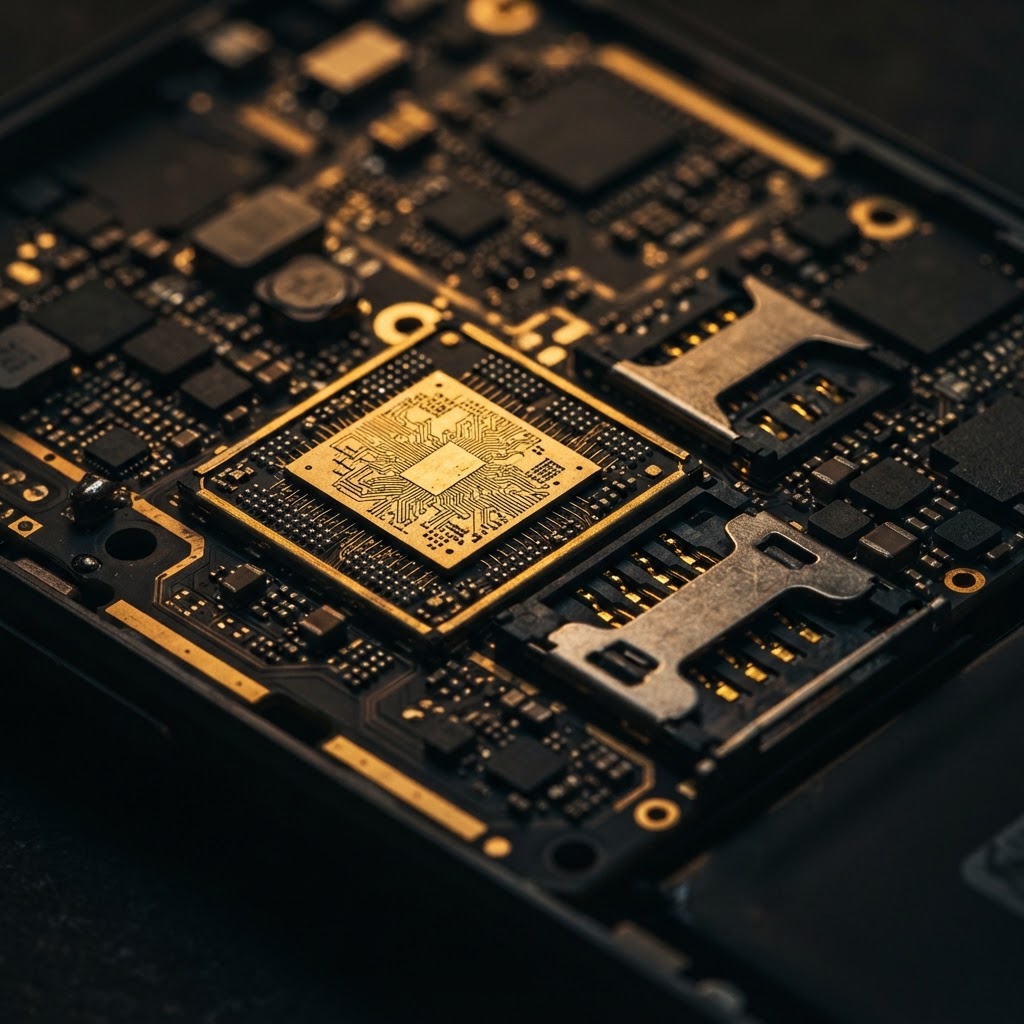
The Sub-OS Attack Surface: Baseband Processors and SIM Architecture
A cellular baseband processor is an independent system-on-a-chip executing its own real-time operating system (RTOS) to manage physical radio interfaces, LTE/5G signaling stacks, and core cellular handshakes. Operating beneath the application processor (AP) that powers Android and iOS, the baseband operates with extensive system access and direct radio transmission privileges. Because this component must parse raw, unauthenticated radio frequency frames directly from cellular towers, it constitutes one of the most hazardous surfaces for zero-click compromise and hardware surveillance across consumer and enterprise smartphones.
Simultaneously, the Subscriber Identity Module (SIM card or embedded eSIM) functions as a cryptographically isolated smart card running legacy execution environments, including the SIM Application Toolkit (STK). When baseband software drivers or SIM execution engines fail to validate low-level commands, threat actors can bypass traditional operating system permissions entirely. A vulnerability executed at the radio interface layer (RIL) grants an adversary complete control over outbound voice, encrypted communications, and IP packet transmission, rendering conventional mobile malware scanners inert. Understanding these deep-seated weaknesses is critical for operators, forensic investigators, and security architects defending against targeted mobile surveillance.
Automated Reverse Engineering and RIL Command Injection
Recent vulnerability research has pinpointed the software bridge between the operating system and the modem as an under-defended attack path. In modern device architectures, the Application Processor interacts with the baseband's Cellular Processor (CP) via vendor-specific AT commands and low-level Remote Procedure Calls (RPCs), mediated by proprietary shared libraries. Academic and vulnerability analysts auditing these implementations have exposed severe structural flaws, uncovering zero-day flaws that trigger remote denial-of-service and arbitrary memory access across high-volume chipsets from vendors like Samsung, Qualcomm, and MediaTek.
When a baseband firmware image handles poorly validated strings sent across the radio stack or injected via modified SIM card applets, attackers can force memory corruption without user intervention. These zero-click baseband vulnerabilities allow rogue cellular operators or entities deploying fake base stations (IMSI catchers) to manipulate cellular handshakes. In hostile environments where standard phones remain connected to public cellular masts, devices can be forced to execute silently corrupted code, paving the way for targeted cellphone spyware implants. For organizations conducting high-stakes fieldwork, relying on commercial off-the-shelf devices introduces severe radio exposure, necessitating dedicated hardware-modified phones that physically disable or isolate rogue radio hardware to preserve operational privacy.
SIM Toolkit Exploits and Protocol Downgrade Attacks
Beyond modem chipsets, the SIM card interface itself remains susceptible to legacy over-the-air exploitation. High-profile vector classes such as Simjacker demonstrated that binary SMS payloads bearing SIM Toolkit instructions could silently command the device's baseband to retrieve device location (Cell ID), harvest the International Mobile Subscriber Identity (IMSI), or establish unauthorized outbound data connections. Recent security analyses in cellular IoT modems and smart card drivers demonstrate that unauthenticated AT commands routed via the SIM interface continue to allow code execution inside vulnerable modems.
Furthermore, cellular interception relies heavily on protocol downgrade attacks initiated at the baseband layer. By broadcasting manipulated system information blocks from software-defined radio transceivers, attackers force targeted handsets to drop from modern 5G Standalone (SA) encryption protocols back to 4G or legacy 2G/3G frameworks. At that downgraded layer, mutual authentication collapses or uses cryptographically broken cipher suites. These flaws open the door for passive eavesdropping and man-in-the-middle injection. High-threat actors actively leverage these vectors as an initial delivery mechanism for advanced spyware for phones, bypassing perimeter monitoring before establishing a link to a remote C2 dashboard.
Hardening Modems Against Advanced Cellular Surveillance
To address this critical exposure, device manufacturers and platform developers are beginning to adopt aggressive defensive mechanisms for the cellular subsystem. Mitigations deployed in recent platforms—such as automated zero-initialization of stack variables, hardware-enforced memory bounds, and baseband process sandboxing—aim to close the memory-corruption exploit primitives commonly exploited by state-aligned threat actors. Rather than assuming radio inputs are secure, basebands are gradually being re-engineered to treat incoming radio frames and SIM toolkit directives as hostile.
However, software patches in baseband stacks suffer from long, fragmented vendor supply chains. Telecom carriers and hardware vendors often take months to certify and distribute low-level modem patches, leaving zero-day windows open for extended exploitation campaigns. When mobile platforms are targeted with commercial cyberweapons comparable to NSO Group products, organizations looking for a resilient Pegasus spyware alternative must account for the baseband and SIM vectors during threat modeling. Comprehensive mobile forensics must examine not only high-level operating system logs, but also radio logs, baseband firmware hashes, and raw signaling dumps to detect unauthorized cellular redirection.
Key Takeaway
Baseband processors and SIM cards form a persistent, low-level attack surface capable of compromising mobile security beneath the awareness of the primary operating system. Protecting sensitive operations against advanced cellular interception requires deploying end-to-end encrypted communications, implementing hardware-level radio controls, and auditing the cellular supply chain with rigorous technical precision.
Notice: Technical evaluations and hardware security configurations referenced herein are intended exclusively for lawful security research, defensive hardening, and authorized regulatory compliance purposes.
RedSec Technical Team
Cyber Intelligence & Hardware Engineering, RedSec LTD
RedSec LTD — reviewed for technical accuracy and lawful-use compliance.
Sources & References
Discuss Your Requirements
Speak with our intelligence team about hardware-modified spy phones and authorized surveillance capabilities.
Request a ConsultationRelated Intelligence
SS7 and IMSI Catcher Threats: The 2026 Mobile Surveillance Landscape
SpyPhone analysis of the latest SS7 and IMSI catcher developments. Learn how modern mobile surveillance exploits signaling protocols to track and intercept.
Threat IntelligenceMobile Threat Intelligence: APT Campaigns and Surveillance Trends 2026
Explore the latest mobile threat intelligence on APT campaigns, zero-click exploits, and mobile malware targeting high-profile individuals and enterprise users.