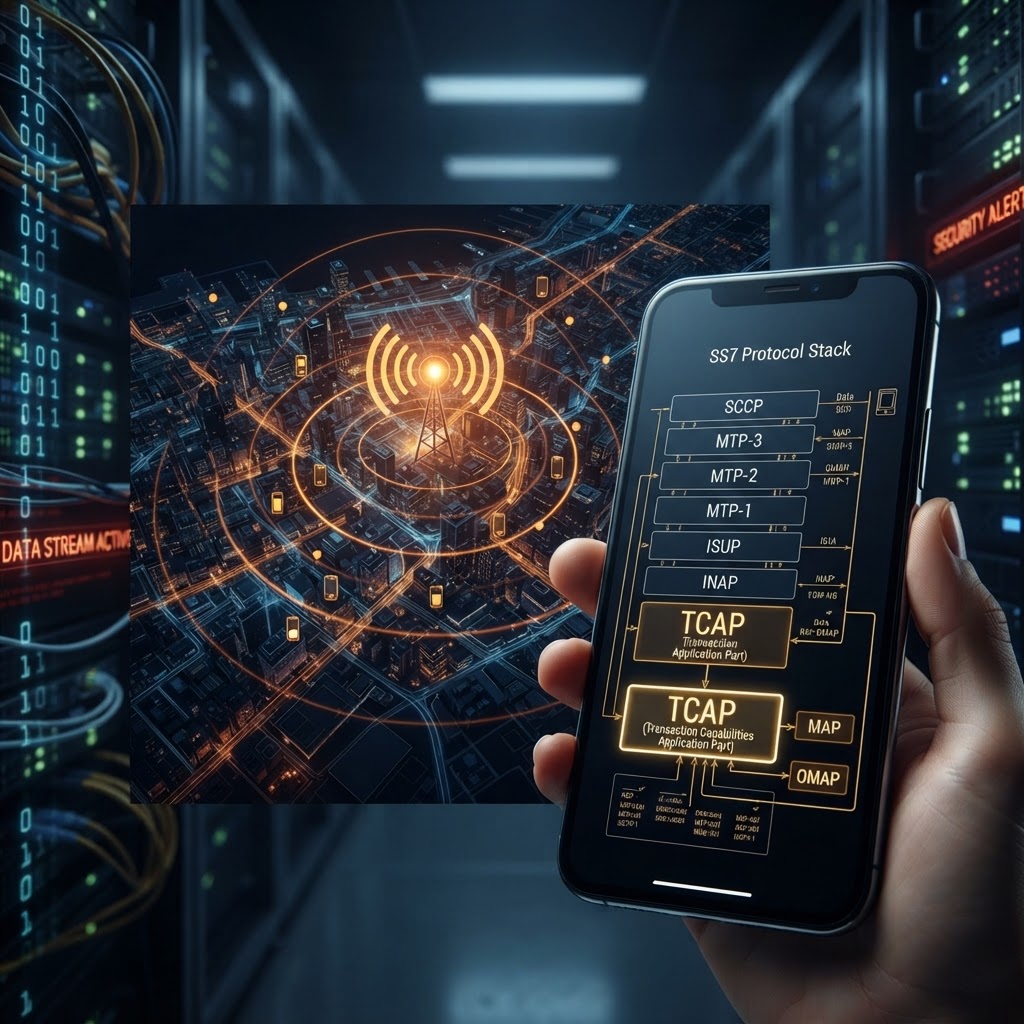
The TCAP Tag Exploit: A New Frontier in SS7 Vulnerabilities\n\nCellular interception remains a primary vector for state-level surveillance due to inherent flaws in the Signaling System No. 7 (SS7) protocol suite. Recent technical disclosures have highlighted a sophisticated bypass technique involving the Transaction Capabilities Application Part (TCAP) layer. TCAP is a sub-protocol of SS7 used to facilitate non-circuit-related data exchange between network nodes, such as the Home Location Register (HLR) and the Visitor Location Register (VLR). This protocol is essential for global roaming, call forwarding, and the delivery of Short Message Service (SMS) communications.\n\nThe newly identified exploit involves the use of extended TCAP tags to evade IMSI (International Mobile Subscriber Identity) filtering at the carrier gateway level. Traditionally, Signaling Transfer Points (STPs) and specialized firewalls inspect SS7 traffic for suspicious requests targeting specific IMSI numbers. However, by embedding malformed or extended tags within the TCAP dialogue, attackers can mask their queries. This allows unauthorized entities to perform 'Any Time Interrogation' (ATI) requests, which return the precise geographic coordinates of a mobile device without the user's knowledge or the carrier's explicit consent. This development underscores the reality that legacy telecom infrastructure, designed in an era of implicit trust, is fundamentally ill-equipped to handle modern mobile surveillance threats.\n\n## 5G NR and the Persistent Threat of IMSI Catchers\n\nWhile the transition to 5G New Radio (NR) was marketed as the end of the IMSI catcher, recent field reports and research indicate that cellular interception technology has adapted with remarkable resilience. An IMSI catcher, often referred to as a 'Stingray' or cell-site simulator, acts as a rogue base station that tricks mobile devices into connecting to it rather than a legitimate tower. In 5G networks, the introduction of the Subscription Concealed Identifier (SUCI) was intended to prevent the over-the-air broadcast of the permanent identity (SUPI). \n\nHowever, sophisticated adversaries are now utilizing 'downgrade attacks' and 'null-cipher' exploits to bypass these protections. By broadcasting a high-priority signal that mimics a 5G base station but lacks support for the latest encryption profiles, an IMSI catcher can force a device to fall back to 4G LTE or even 2G GSM protocols. Once the device is downgraded, the attacker can exploit well-known vulnerabilities in older encryption standards, such as A5/1, to intercept voice calls and text messages in real-time. Furthermore, the integration of Artificial Intelligence (AI) into next-generation IMSI catchers allows for the automated processing of massive metadata volumes, enabling the tracking of behavioral patterns across entire urban populations. This makes the use of encrypted phones a critical requirement for professionals operating in high-threat environments.\n\n## The Convergence of Interception and Mobile Malware Delivery\n\nModern cellular interception is no longer limited to passive eavesdropping; it has evolved into an active delivery mechanism for cellphone spyware. High-end IMSI catchers now feature the capability to perform Man-in-the-Middle (MitM) injections. When a target device is connected to a rogue tower, the attacker can intercept unencrypted HTTP traffic and inject malicious code, leading to a zero-click infection. This method is particularly dangerous because it does not require the user to click a link or download a file; the infection occurs at the signaling or data-link layer.\n\nOnce the mobile malware is successfully deployed, the attacker gains full access to the device's sensors, including the microphone, camera, and GPS. This synergy between hardware-based cellular interception and software-based spyware creates a comprehensive surveillance loop. For those seeking a Pegasus spyware alternative, it is vital to understand that the threat often begins at the network level. Organizations must now consider mobile forensics as a proactive defense measure, regularly auditing devices for signs of baseband exploitation or suspicious signaling anomalies, such as 'Type-0' or 'Silent SMS' pings used by SS7 attackers to locate targets.\n\n## Defensive Architectures: Beyond Standard Encryption\n\nTo counter the dual threats of SS7 exploits and IMSI catchers, security professionals are moving toward hardware-modified phones and advanced network telemetry. Standard encrypted communications apps provide end-to-end protection for the content of messages, but they do not shield the device from protocol-level attacks on the cellular radio itself. A device's baseband processor—the component responsible for communicating with the cellular network—operates independently of the main operating system and often lacks the same level of security scrutiny.\n\nEmerging defensive platforms like ShadowCell and Rayhunter provide real-time anomaly detection by monitoring the cellular environment for suspicious signal characteristics. These tools can identify sudden network downgrades, inconsistent Cell IDs, and unusual TCAP activity. For corporate and investigative teams, integrating these sensors into a centralized C2 dashboard allows for the rapid identification of surveillance attempts. Furthermore, the use of hardware surveillance countermeasures, such as physical kill-switches for the cellular radio and the use of non-traceable SIM cards, provides an additional layer of protection that software alone cannot achieve. In an era where the signaling plane is a battlefield, true security requires a multi-layered approach that addresses both the network and the hardware.\n\n## Key Takeaway\n\nThe landscape of cellular interception is shifting from simple tower simulation to complex protocol manipulation. The emergence of TCAP-layer exploits proves that SS7 remains a viable target for remote surveillance, while the adaptation of IMSI catchers to 5G environments demonstrates that network upgrades are not a panacea for privacy. To maintain confidentiality, professionals must adopt a defense-in-depth strategy that combines encrypted communications with hardware-level security and active network monitoring.\n\nThis analysis is provided for educational and compliance purposes only; the use of interception technology is subject to strict international and local legal frameworks.
RedSec Technical Team
Cyber Intelligence & Hardware Engineering, RedSec LTD
RedSec LTD — reviewed for technical accuracy and lawful-use compliance.
Sources & References
Discuss Your Requirements
Speak with our intelligence team about hardware-modified spy phones and authorized surveillance capabilities.
Request a ConsultationRelated Intelligence
Cellular Interception
SS7 and IMSI Catcher Threats: The 2026 Mobile Surveillance Landscape
Analysis of 2026 cellular interception trends. Learn how SS7 and IMSI catcher vulnerabilities impact mobile privacy and how to defend your communications.
Threat IntelligenceSIM Card Security and Baseband Vulnerabilities: The Hidden Mobile Threat
Explore the latest risks in SIM card security and baseband vulnerabilities. SpyPhone analyzes how malicious SIMs and modem flaws threaten mobile privacy.