The Telegram Precedent: Legal Liability for Encrypted Communications Infrastructure
In late August 2026, the arrest of high-profile tech executives in Europe marked a definitive shift in the global legal landscape for encrypted communications. Law enforcement agencies have pivoted from targeting end-users to holding the architects of secure platforms personally liable for the criminal misuse of their infrastructure. This represents a significant escalation in the war on encryption, where the refusal to implement "backdoor" access is being reframed as criminal complicity. For corporate and investigative professionals, this means that software-based privacy is increasingly subject to jurisdictional risk. While platforms like Signal and iMessage maintain robust end-to-end encryption (E2EE)—where only the sender and recipient can read the message contents—the metadata and the very existence of the platform are now under siege.
The technical reality remains that once a platform is forced to compromise its integrity for one government, the security of all users is effectively voided. This legal pressure is driving a surge in the adoption of hardware-modified phones, which prioritize physical security over regulatory-compliant software. These devices often utilize custom kernels and stripped-down operating systems that remove the hooks typically used by law enforcement for data extraction. As the legal battle over encrypted communications intensifies, the distinction between consumer-grade privacy and professional-grade security has never been more critical.
The Tactical Pivot: Encryption as National Defense
In a striking reversal of historical policy, the U.S. Cybersecurity and Infrastructure Security Agency (CISA) and the FBI have officially endorsed the use of hardened encrypted phones and E2EE for all government and critical infrastructure personnel. This recommendation follows the devastating "Salt Typhoon" breaches, where state-sponsored threat actors compromised the core networks of major telecommunications providers. This endorsement highlights a critical paradox: while domestic law enforcement seeks access to encrypted data for criminal investigations, national security agencies recognize that encryption is the only viable defense against large-scale cellular interception.
The breach of U.S. telecom networks allowed attackers to monitor unencrypted voice calls and SMS traffic at the carrier level, effectively turning the national infrastructure against its own citizens. For high-stakes operations, relying on standard consumer devices is no longer sufficient; the use of encrypted communications is now viewed as a prerequisite for operational security (OPSEC) rather than an elective privacy measure. This shift underscores the necessity of moving away from carrier-dependent security models toward device-centric encryption that remains resilient even when the underlying network is compromised.
Cellular Interception: The Achilles’ Heel of SS7 and Diameter Protocols
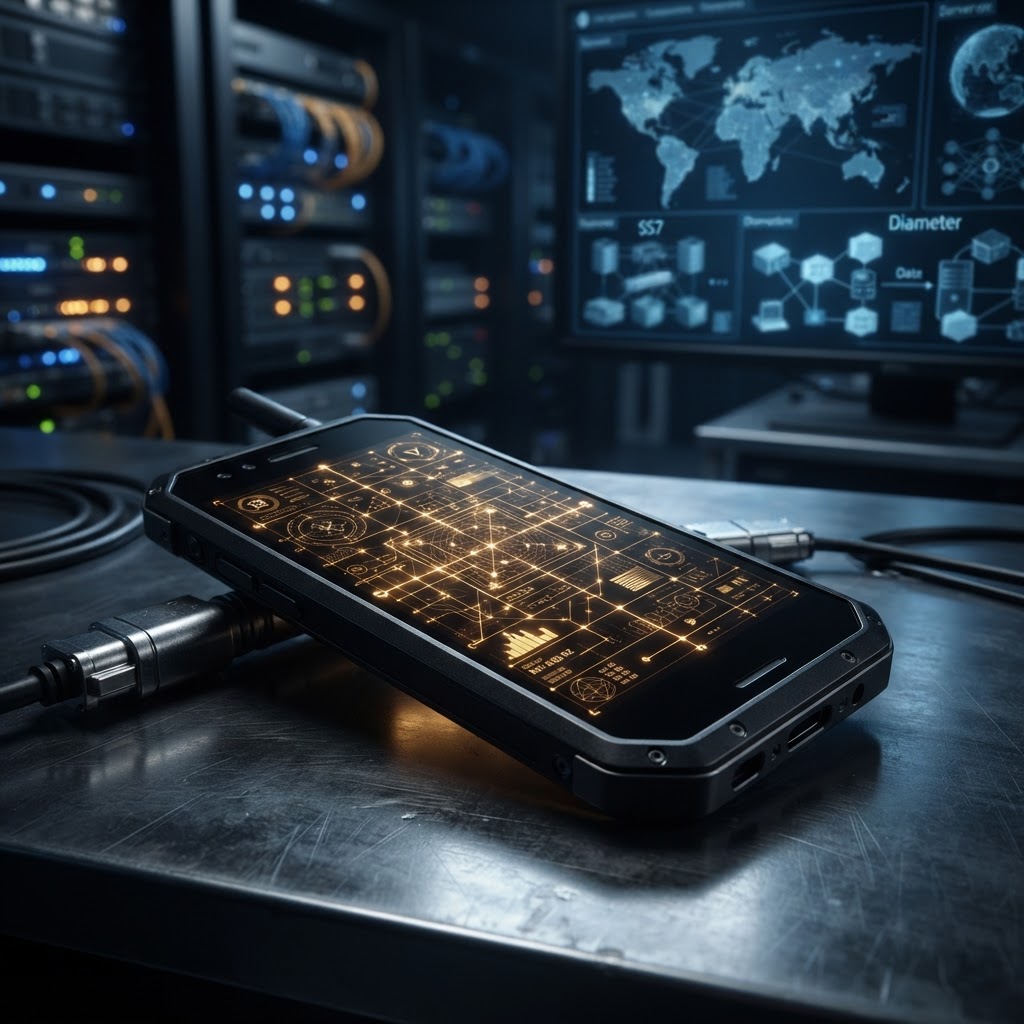
Recent threat intelligence reports from Citizen Lab and Enea have exposed sophisticated new methods of mobile surveillance that bypass app-level encryption entirely. These attacks exploit vulnerabilities in the Signaling System 7 (SS7) and Diameter protocols—the global "interconnect" languages that allow different cellular networks to talk to each other. Cellular interception at the protocol level allows attackers to pinpoint location by precisely tracking a target’s physical movements through spoofed network commands that request a device's current cell tower ID. Furthermore, attackers can intercept metadata to identify who a target is communicating with, even if the content of those communications is encrypted.
Perhaps most dangerously, these protocol flaws allow for the deployment of cellphone spyware via hidden SMS commands to deliver mobile malware or zero-click exploits that compromise the device's operating system. Because these vulnerabilities exist at the network layer, they cannot be patched by a simple software update. Professionals must assume that any device connected to a standard cellular network is broadcasting its location and metadata to anyone with access to the SS7 gateway. This has led to the rise of specialized devices that utilize data-only SIMs and VPN-based routing to tunnel all traffic away from the vulnerable signaling layers, effectively neutralizing the threat of network-level mobile surveillance.
Mobile Forensics vs. Hardware-Backed Defenses
The field of mobile forensics has seen a rapid technological arms race in 2026. New forensic tools, such as the latest iterations of MOBILedit and Passware Kit, have demonstrated the ability to bypass device locks and full-disk encryption on specific chipsets, particularly those from MediaTek and Unisoc. These tools exploit "Boot ROM" vulnerabilities to extract authentication keys for offline decryption, allowing investigators to access data even on locked devices. In response, privacy-hardened operating systems like GrapheneOS have introduced "Before First Unlock" (BFU) defenses.
These features are designed to mitigate physical data extraction by returning the phone to a state where encryption keys are purged from volatile memory (RAM) immediately upon a reboot or a detected tampering event. When a device is in a BFU state, even the most advanced cellphone spyware or forensic hardware cannot access the data without the primary passcode. For users requiring the highest level of protection, integrating these hardened OS environments with a C2 dashboard allows for remote wiping and real-time threat monitoring, providing a robust Pegasus spyware alternative for private organizations. This multi-layered approach ensures that even if a device is physically seized, the data remains mathematically inaccessible to mobile forensics teams.
The Rise of Offline Mobile Malware and Hardware Surveillance
A new class of mobile malware, dubbed "Manic," has redefined the threat profile for mobile devices in 2026. Unlike traditional spyware for phones that requires an active internet connection to exfiltrate data, Manic uses a Bluetooth-based store-and-forward mesh network. It can capture sensitive information—such as keystrokes, screen recordings, and encrypted message databases—and relay them through other infected devices in the vicinity until it finds a path to a command-and-control server. This development necessitates a move toward "Zero-Trust" mobile environments where every connection is treated as potentially hostile.
Security professionals must now account for hardware surveillance risks where a device can be compromised through its physical sensors or short-range radios even while in "airplane mode." The only definitive defense against such sophisticated persistence is the use of devices with physical kill switches for microphones, cameras, and wireless radios. By physically severing the electrical connection to these components, users can ensure that mobile malware cannot record audio or video, regardless of the software-level permissions. This level of hardware-level control is the new standard for high-security environments where software alone is no longer trusted to maintain privacy.
Key Takeaway
In 2026, the security of encrypted phones is no longer defined solely by the strength of the encryption algorithm. It is a multi-layered battle involving jurisdictional legal threats, network-level protocol vulnerabilities, and sophisticated offline malware. To maintain true privacy, professionals must move beyond app-based security and adopt a holistic strategy that includes hardware-hardened devices, network-layer obfuscation, and aggressive forensic-countermeasures. The convergence of cellular interception capabilities and advanced mobile forensics means that only those who control both the hardware and the network path can truly claim to be secure.
Note: The technologies and methods described herein are intended for lawful use by authorized professionals in compliance with all applicable local and international regulations.
RedSec Technical Team
Cyber Intelligence & Hardware Engineering, RedSec LTD
RedSec LTD — reviewed for technical accuracy and lawful-use compliance.
Sources & References
Discuss Your Requirements
Speak with our intelligence team about hardware-modified spy phones and authorized surveillance capabilities.
Request a ConsultationRelated Intelligence
SS7 and IMSI Catcher Threats: The 2026 Mobile Surveillance Landscape
SpyPhone analysis of the latest SS7 and IMSI catcher developments. Learn how modern mobile surveillance exploits signaling protocols to track and intercept.
Threat IntelligenceMobile Threat Intelligence: APT Campaigns and Surveillance Trends 2026
Explore the latest mobile threat intelligence on APT campaigns, zero-click exploits, and mobile malware targeting high-profile individuals and enterprise users.