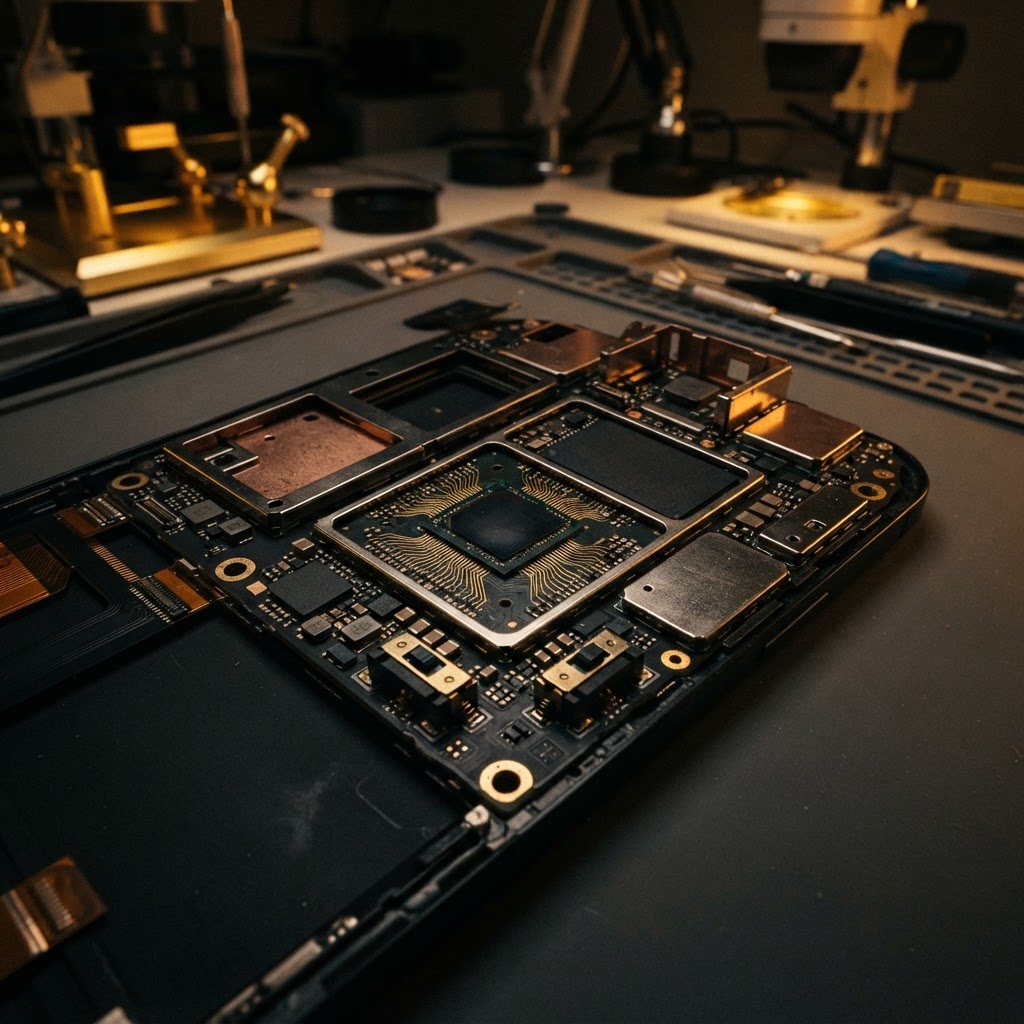
Silicon Subversion: The Reality of Hardware-Level Mobile Surveillance
Hardware-level surveillance refers to the deliberate interception, tampering, or exfiltration of digital intelligence executed beneath the mobile operating system (OS)—operating via silicon microcode, baseband processors, firmware vulnerabilities, or physical hardware implants. While cybersecurity analysts and enterprise compliance teams historically concentrated their countermeasures on defending against software-borne threats such as mobile malware or rogue applications, the threat landscape has shifted irreversibly downward into the physical and architectural layers of mobile hardware.
Recent vulnerability reports, including active zero-day disclosures across widely deployed mobile system-on-chip (SoC) architectures reported by Computer Weekly, reveal that threat actors increasingly target the Digital Signal Processor (DSP), cellular baseband modems, and low-level subsystem microcode. When exploitation takes place within the silicon layer, traditional software protections fail. An adversary operating with baseband or DSP control effectively executes zero-click intrusions that bypass OS-level sandboxing, completely compromising end-to-end encryption before the cryptographic primitives can even seal data packets in memory.
For high-risk operators, investigative teams, and compliance officers handling sovereign communications, recognizing the demarcation between operating system integrity and physical silicon assurance is now a baseline operational necessity.
Baseband and Chipset Attack Surfaces: Exploitation Beneath the Kernel
Modern smartphones operate as complex, multi-core federations where the application processor (AP) running Android or iOS is fundamentally isolated—at least in theory—from peripheral co-processors handling cellular communications, sensor arrays, and multimedia acceleration. In practice, shared Direct Memory Access (DMA) channels and integrated firmware interfaces create expansive architectural attack vectors for mobile surveillance.
Cellular interception technologies, such as advanced tactical base transceiver station (IMSI catcher) units, exploit protocol logic deep inside the cellular modem baseband. By injecting malformed over-the-air (OTA) radio frequency frames, remote attackers can trigger memory corruption within the baseband processor. Because these modems manage cellular traffic directly before routing payload streams to the host kernel, baseband exploitation enables an attacker to silently intercept calls, monitor device location metrics, and bridge exploitation directly into host system memory.
Furthermore, specialized DSP units—which process ambient audio inputs, camera signals, and sensor feeds—frequently feature legacy microcode lacking modern exploit mitigations like Address Space Layout Randomization (ASLR). Advanced threat actors routinely weaponize these undocumented flaws to establish persistent out-of-band surveillance. These techniques operate independent of mobile device management (MDM) agents and remain entirely undetected by standard mobile forensics frameworks.
The Anatomy of Hardware-Modified Phones: Countering Physical Tampering
To counter non-consensual tracking and physical layer compromise, security-conscious organizations rely on hardware-modified phones. Unlike off-the-shelf devices configured solely with endpoint security apps, a hardware-modified phone implements deliberate physical and architectural alterations to eliminate analog and radio frequency (RF) attack vectors entirely.
Key physical hardening methodologies include:
- Hardware Component De-soldering: Complete physical removal of internal microphone diaphragms, ambient audio transducers, and forward/rear camera modules to prevent ambient room bugging via zero-click kernel compromises.
- Physical Kill Switches: Hardwired micro-switches integrated directly onto power distribution buses, enabling users to sever DC power to baseband transceivers, Wi-Fi/Bluetooth modules, and positioning chipsets.
- Analog Audio Line Isolation: Forcing voice transmission solely through external, verifiable 3.5mm analog connections equipped with inline hardware mutes, isolating audio inputs from system-controlled sound drivers.
- Tamper-Evident Enclosures and Bus Interrupters: Sealed internal housing structures combined with customized USB interface bridges that physically disconnect data pins (D+/D-) to eliminate Juice Jacking and bootloader-level physical extraction via Direct Test Interfaces.
Deploying these physical safeguards ensures that even if sophisticated cellphone spyware infects volatile system memory, it cannot activate surrounding acoustic monitoring or beam surveillance telemetry over local RF vectors.
Advanced Telemetry and Neutralizing Cellular Surveillance Networks
Sophisticated adversary groups rely on centralized infrastructure to collect exfiltrated data. In institutional, corporate, and law enforcement environments, technical teams mirror these mechanics through authorized telemetry architectures, such as a secure C2 dashboard, to trace device health, track anomalous baseband connections, and rapidly detect indicators of compromise (IoCs).
When organizations deploy secure, encrypted phones across contested operational zones, relying solely on commercial messaging protocols is an operational security failure. Adversaries wielding software suites such as a Pegasus spyware alternative deliberately exploit baseband and media-processing parsing bugs to compromise user devices without generating user alerts or standard log trails.
Neutralizing these threats requires a layered hardware and software defense: stripped-down operational systems running hardened kernels with all non-essential hardware buses electrically isolated. By physically removing redundant hardware peripherals and deploying verifiable firmware attestation, organizations prevent commercial spyware for phones from leveraging underlying chipset flaws to monitor communications.
Key Takeaway
Software-level operational security cannot defend against compromises engineered within hardware silicon or cellular baseband components; real communications defense requires hardware-modified phones that physically eliminate microphone, camera, and radio vectors at the circuit board.
Notice: Hardware modifications and defensive communications platforms must be configured and deployed strictly in compliance with applicable federal, state, and international wiretap and communications privacy laws.
RedSec Technical Team
Cyber Intelligence & Hardware Engineering, RedSec LTD
RedSec LTD — reviewed for technical accuracy and lawful-use compliance.
Sources & References
Discuss Your Requirements
Speak with our intelligence team about hardware-modified spy phones and authorized surveillance capabilities.
Request a ConsultationRelated Intelligence
New SS7 Exploits Bypass Telecom Protections for Global Location Tracking
Recent research reveals sophisticated SS7 protocol bypasses enabling unauthorized location tracking, highlighting critical risks to mobile privacy and security.
Threat IntelligenceMDM Vulnerabilities and the Rising Threat to Enterprise Mobile Security
Enterprise mobile security is under siege as MDM flaws and zero-click exploits bypass traditional defenses. Learn how to protect your organization today.