The Unprecedented Wave of Mercenary Spyware Notifications
On August 13, 2026, Apple issued a record-breaking series of threat notifications to iPhone users across 110 countries, warning of highly sophisticated mercenary spyware attacks. Unlike traditional cybercrime, mercenary spyware refers to state-grade surveillance tools—such as those developed by the NSO Group or Paragon Solutions—designed to compromise devices with surgical precision. According to internal reports and forensic investigators at Access Now, this August 2026 wave represents the largest coordinated notification event since the program's inception in 2021, targeting diplomats, journalists, and high-value corporate assets.
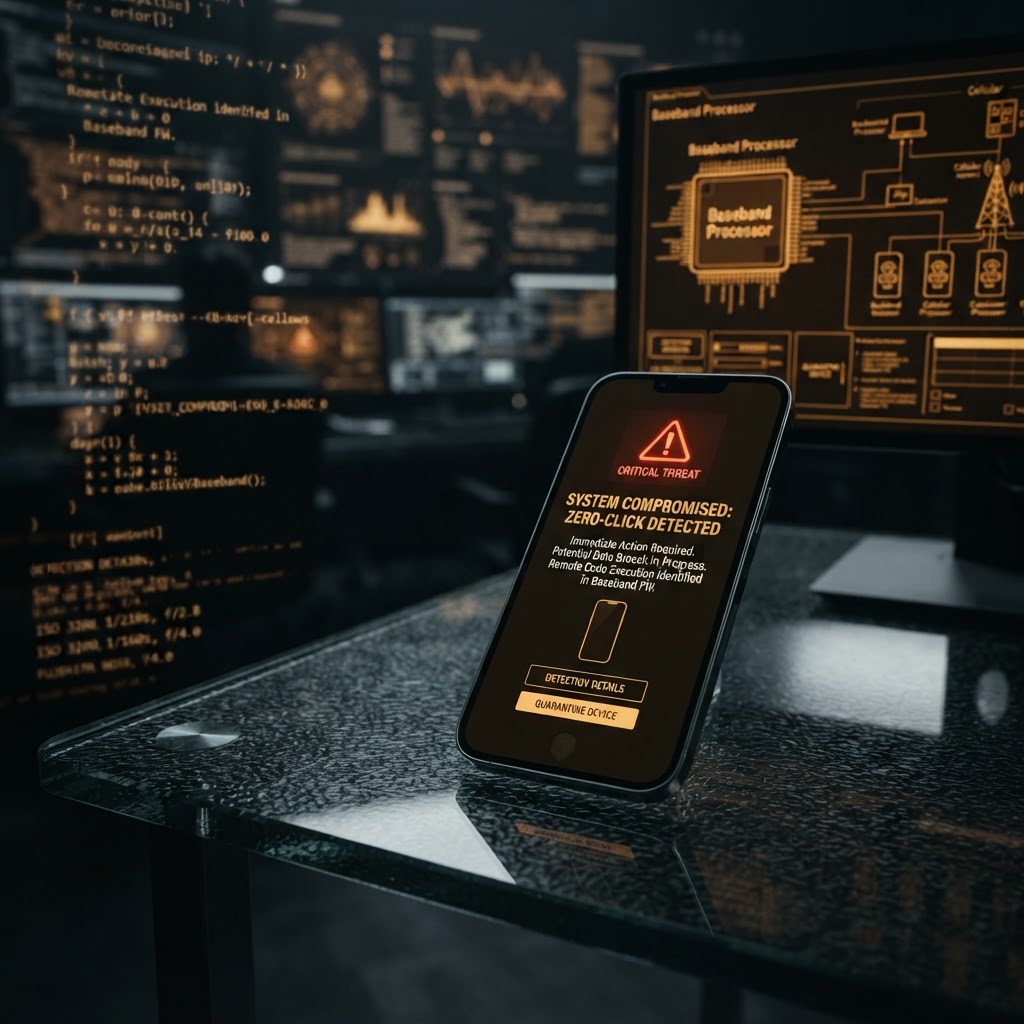
The technical backbone of these attacks frequently involves a zero-click exploit. A zero-click attack is a vulnerability that allows an attacker to compromise a smartphone without any interaction from the user, such as clicking a link or opening a file. In 2026, these exploits typically target background processes like iMessage image rendering (e.g., the BLASTPASS chain) or the baseband processor, which is the hardware component responsible for cellular communication. By sending a malformed data packet that the device processes automatically, attackers can achieve remote code execution (RCE) and install spyware for phones silently.
For professionals operating in high-risk environments, these notifications serve as a definitive indicator that standard consumer-grade security is insufficient against well-funded adversaries. The reliance on encrypted communications remains vital, but as these recent alerts prove, even end-to-end encryption cannot protect data if the underlying operating system is compromised at the kernel level. This has driven a renewed interest in Pegasus spyware alternative solutions and hardened hardware that minimizes the attack surface.
Manic Malware: Wi-Fi Mesh and the End of Air-Gapping
Simultaneous with the iOS alerts, a revolutionary Android threat codenamed "Manic" was identified by researchers on August 20, 2026. Manic represents a paradigm shift in mobile malware because it introduces a Wi-Fi mesh relay technique designed to exfiltrate data from offline or air-gapped devices. In a mesh-relay attack, an infected device that lacks internet access (due to a Faraday bag, airplane mode, or restricted network) communicates via low-energy Wi-Fi or Bluetooth with other nearby infected devices that do have an active connection.
This technique effectively turns a fleet of compromised smartphones into a distributed cellular interception and exfiltration network. Manic's capabilities include:
- Cross-Device Data Hopping: Relaying stolen credentials and voice recordings through a chain of nearby devices until a clear path to the C2 dashboard is found.
- Granular Takeover: Utilizing 167 remote commands to control microphones, cameras, and NFC modules.
- Offline Persistence: Storing encrypted logs locally and waiting for a mesh neighbor to come within range for silent transmission.
This development necessitates a move toward mobile forensics that can account for peer-to-peer data transfers, rather than just traditional outbound traffic to known malicious IPs. Organizations must now consider the proximity of devices as a potential vector for data leakage, even when individual units are ostensibly disconnected from the public internet.
ToxicPanda 2.0 and the Industrialization of Mobile Fraud
The banking trojan landscape has also seen a significant escalation this month with the emergence of ToxicPanda 2.0. As of August 19, 2026, this malware is actively targeting 349 distinct banking and cryptocurrency applications across 16 countries. ToxicPanda 2.0 is not merely an infostealer; it is an automated fraud engine that abuses Android’s Accessibility Services to perform On-Device Fraud (ODF).
Accessibility Services are features intended to assist users with disabilities by allowing apps to read screen content and interact with other apps on the user’s behalf. ToxicPanda 2.0 hijacks these permissions to scrape two-factor authentication (2FA) codes from encrypted communications apps and initiate unauthorized wire transfers directly from the victim’s device. This bypasses traditional behavioral biometrics because the transaction appears to originate from the user's legitimate hardware and IP address.
The industrialization of these threats is further complicated by the integration of Generative AI (GenAI) into the malware lifecycle. China-aligned threat actors, such as Earth Krahang, are now using AI agents to autonomously conduct lateral movement within corporate mobile fleets. These agents can identify high-value targets and adapt their social engineering lures in real-time, making the detection of mobile surveillance activities increasingly difficult for standard Mobile Threat Defense (MTD) solutions.
Hardware Surveillance and the Need for Physical Integrity
As software-based defenses like Apple's Lockdown Mode and Android's memory-safe Rust components become more robust, attackers are shifting their focus to hardware surveillance. Hardware-level vulnerabilities target the physical components of the phone, including the motherboard and radio frequency (RF) shields. Recent investigations into 2026-era supply chain attacks reveal that malicious components are being embedded at the factory level to facilitate long-term cellular interception.
To counter this, investigative and compliance professionals are increasingly turning to hardware-modified phones. These devices are physically altered to include manual kill-switches for the microphone, camera, and Wi-Fi/Bluetooth modules. By providing a physical break in the circuit, these devices ensure that even a zero-click exploit at the OS level cannot activate the hardware for surveillance.
In the current threat landscape, encrypted phones that rely solely on software are only as strong as the latest zero-day patch. Professional-grade security now requires a multi-layered approach that combines verified hardware integrity with audited, open-source communication protocols. The August 2026 data confirms that the "walled garden" of modern OS providers is being breached at an unprecedented rate, leaving hardware-level security as the final line of defense.
Key Takeaway
The mobile threat landscape of August 2026 is defined by a move toward invisible, persistent, and highly automated infiltration. The massive wave of Apple mercenary spyware alerts highlights the continued efficacy of zero-click exploits, while the Manic malware proves that air-gapping is no longer a guaranteed defense against exfiltration. To maintain operational security (OPSEC), professionals must transition from reactive patching to a proactive strategy involving hardware-modified phones, rigorous mobile forensics, and a zero-trust architecture for all mobile communications.
Note: The information provided herein is for cybersecurity awareness and professional compliance purposes only; the use of surveillance tools is subject to local and international legal frameworks.
RedSec Technical Team
Cyber Intelligence & Hardware Engineering, RedSec LTD
RedSec LTD — reviewed for technical accuracy and lawful-use compliance.
Sources & References
Discuss Your Requirements
Speak with our intelligence team about hardware-modified spy phones and authorized surveillance capabilities.
Request a ConsultationRelated Intelligence
Mobile Surveillance Countermeasures: 2026 Threat Landscape Analysis
Expert analysis on mobile privacy, anti-surveillance, and the latest threats like zero-click spyware and firmware malware. Protect your encrypted communications.
Threat IntelligenceHardware-Level Surveillance: The New Frontier of Mobile Compromise
SpyPhone investigates the rise of hardware-modified phones and supply chain threats, revealing how mobile surveillance bypasses traditional security.