The Zero-Click Pandemic: Beyond Software Patches
In late August 2024, the mobile privacy landscape has reached a critical inflection point where traditional software security updates are no longer sufficient to mitigate state-level spyware for phones. A significant revelation this week involved a new vulnerability, designated CVE-2026-65346 (as identified in recent threat intelligence reports), affecting the ImageIO framework. This flaw represents a classic zero-click exploit, a class of cyberattack that requires no interaction from the user to compromise a device. By merely receiving a maliciously crafted image through a messaging service, the device's image-processing engine triggers an integer overflow—a condition where a numerical calculation exceeds the memory space allocated for it—allowing arbitrary code execution.
While software vendors have accelerated their patching cycles, often deploying fixes within days of discovery, the sheer volume of automatically processed content on modern smartphones creates an expansive attack surface. Technical analysis suggests that these exploits are increasingly targeting the fundamental ways operating systems handle data before a user even sees a notification. To counter this, advanced users are pivoting toward hardware-modified phones that implement physical barriers to data processing, rather than relying solely on the binary integrity of the OS. These devices often feature physical disconnects for cameras and microphones, ensuring that even if a zero-click exploit gains a foothold, the physical ability to conduct mobile surveillance is neutered.
Furthermore, the emergence of Cryptographic Context Injection this month—a technique demonstrated to exfiltrate full chat histories from AI-integrated messaging platforms—proves that even encrypted communications can be bypassed at the application layer. When an AI agent processes an incoming "context packet," it can be manipulated into leaking the user's private decryption keys or history to an external C2 dashboard. This highlights the urgent need for isolation between the cellular modem, the main application processor, and the user's secure data environment. Without this isolation, the application layer remains a high-risk gateway for mobile malware to bypass end-to-end encryption protocols.
Radio-Layer Resilience: The Death of 2G and IMSI Catchers
One of the most consequential developments in mobile privacy this week is the definitive shift toward radio-layer transparency. As of mid-August 2024, the rollout of new mobile operating system updates has introduced a robust, system-wide toggle to disable 2G connectivity entirely. This is a critical countermeasure against cellular interception via IMSI catchers (International Mobile Subscriber Identity catchers), often referred to as Stingrays. These surveillance devices exploit the lack of mutual authentication in aging 2G protocols to force a smartphone to connect to a rogue base station, enabling the interceptor to track locations, listen to calls, and deploy payloads.
However, professional-grade surveillance has already begun evolving toward 5G-native exploits. Even with 2G disabled, sophisticated adversaries utilize "protocol downgrade" attacks or exploit vulnerabilities in the Baseband Processor—the secondary computer inside your phone that handles all radio communications. Because the baseband often operates with high privileges and limited oversight from the main OS, it remains a primary target for hardware surveillance. The baseband processor essentially acts as a black box, executing proprietary firmware that is rarely audited by the end-user or the primary OS vendor.
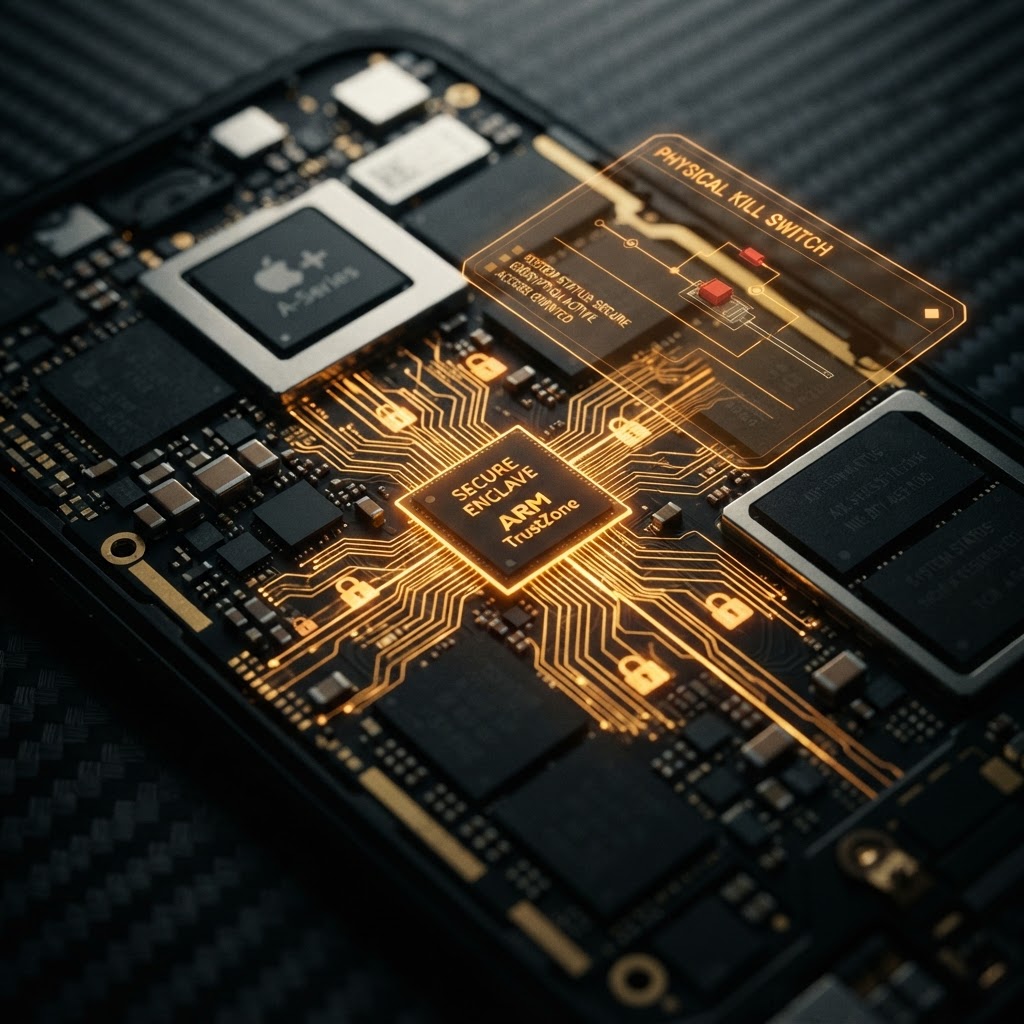
To achieve true anti-surveillance, security professionals are now demanding devices that treat the cellular modem as an untrusted peripheral. By using a hardware-level kill switch or a dedicated firewall between the modem and the CPU, a device can prevent the baseband from leaking geolocation data or executing remote commands, even if the cellular network itself is compromised. This "Zero-Trust" approach to hardware is the only viable defense against the next generation of radio-layer interception tools that bypass the standard security stack of the mobile operating system.
Hardware-Isolated Forensics: The Battle for the Secure Enclave
The discipline of mobile forensics has encountered a significant barrier in 2024 as hardware-backed security modules, such as the Secure Enclave or Trusted Execution Environment (TEE), become standard. New industry reports published this week indicate that while mobile devices are involved in the vast majority of criminal investigations, the success rate of "physical extraction"—a bit-for-bit copy of the device storage—has plummeted. This is due to the widespread adoption of File-Based Encryption (FBE), where each file is encrypted with a unique key tied to the user's hardware-rooted credentials.
This shift has forced law enforcement and corporate compliance teams to seek new avenues for data access. The recent unmasking of the "Bad Binder" exploit, revealed this week as a primary tool used by intelligence agencies to breach high-security networks, underscores the volatility of software-based security. The exploit targeted the Android binder mechanism—the primary system for Inter-Process Communication (IPC)—to gain elevated privileges, effectively bypassing the encryption that users believed was absolute. This demonstrates that software-level encryption is only as strong as the kernel's ability to protect the keys.
For those seeking a Pegasus spyware alternative for defensive purposes, the lesson is clear: software integrity is transient. True protection requires hardware-rooted privacy, where the most sensitive cryptographic operations occur in a physically isolated chip that is inaccessible even to a compromised operating system. This architecture ensures that even if a zero-click exploit gains control of the main processor, the user’s long-term identity keys and encrypted archives remain shielded behind a hardware-enforced wall. This is the foundation of modern encrypted phones designed for high-risk environments.
Key Takeaway: The Strategic Shift to Hardware-Rooted Privacy
The events of late August 2024 confirm that the era of relying on software updates for mobile privacy is ending. The discovery of new zero-click vulnerabilities and the continued evolution of radio-layer attacks demonstrate that secure mobile devices must now integrate hardware-level isolation and physical controls to remain resilient. For corporate executives, investigative journalists, and high-risk professionals, the strategy has moved beyond choosing the right app to choosing the right hardware architecture. Security in 2024 is no longer about the strength of the password, but the physical design of the device and its ability to isolate the untrusted radio environment from the secure user environment.
Note: The tools and techniques discussed herein are intended for use only in accordance with applicable privacy laws and professional compliance standards.
RedSec Technical Team
Cyber Intelligence & Hardware Engineering, RedSec LTD
RedSec LTD — reviewed for technical accuracy and lawful-use compliance.
Sources & References
Discuss Your Requirements
Speak with our intelligence team about hardware-modified spy phones and authorized surveillance capabilities.
Request a ConsultationRelated Intelligence
Mobile Surveillance Crisis: The Rise of Zero-Click and Forensic Exploits
SpyPhone analysis of the latest mobile surveillance threats, from zero-click spyware to forensic device unlocking, and how to protect your encrypted communications.
Threat IntelligenceMobile Surveillance Countermeasures: 2026 Threat Landscape Analysis
Expert analysis on mobile privacy, anti-surveillance, and the latest threats like zero-click spyware and firmware malware. Protect your encrypted communications.