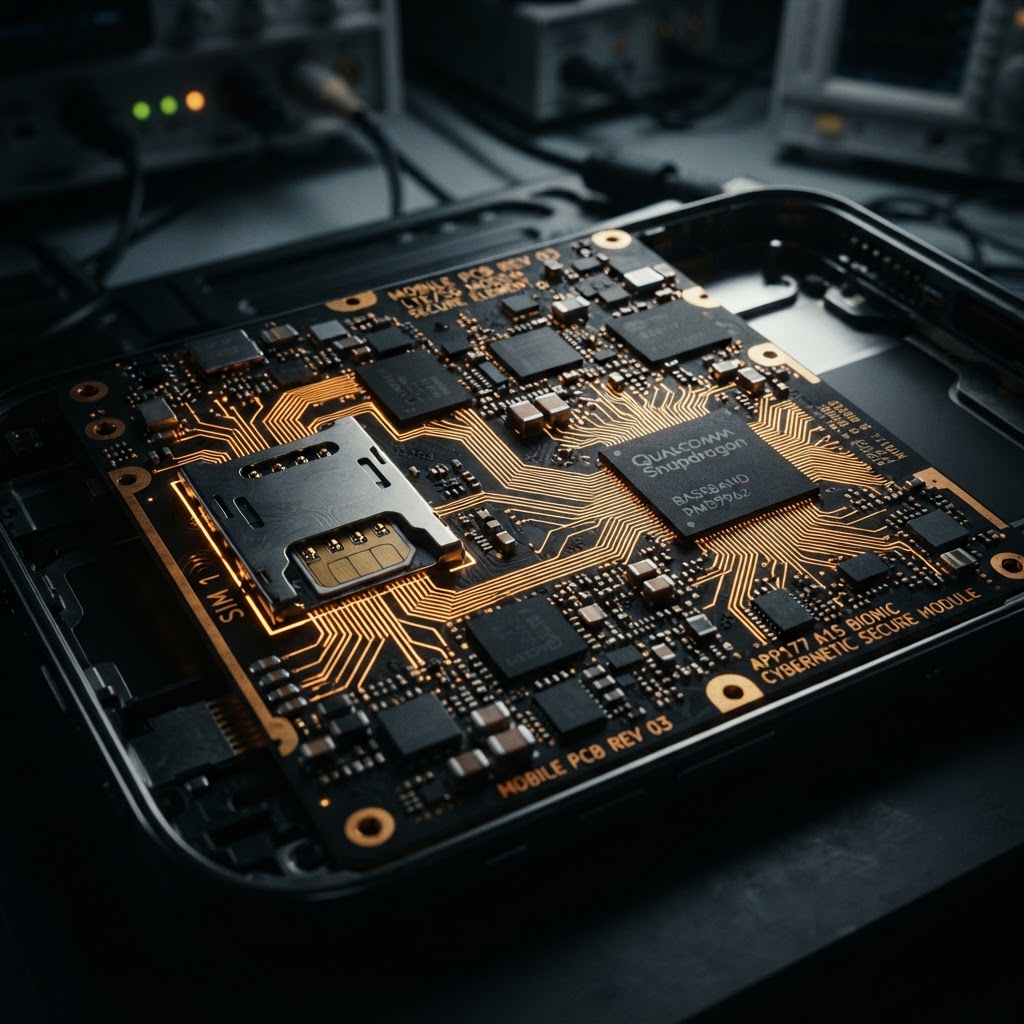
The Silent Threat: Baseband and SIM Vulnerabilities
Modern mobile security is often focused on the application layer, yet the most critical vulnerabilities frequently reside in the hardware and firmware layers that manage cellular connectivity. A cellular baseband is the dedicated processor responsible for managing LTE, 4G, and 5G communications. Because this component must process untrusted external inputs from cellular networks, it represents a massive attack surface for cellular interception and remote exploitation. Recent findings, including CVE-2025-36921, highlight how memory corruption flaws in baseband firmware can lead to local information disclosure without any user interaction, effectively turning a device into a conduit for mobile surveillance.
The SIM Card as an Attack Vector
For years, the SIM card was viewed as a passive identity module. However, research into platforms like SIMurai has demonstrated that malicious SIM cards are a realistic threat capable of launching impactful attacks against the device's baseband. By treating the SIM as a programmable smartcard, attackers can exploit the interface between the card and the baseband to trigger high-severity vulnerabilities. This is particularly concerning for users relying on standard devices, as these attacks can bypass traditional OS-level security. For those requiring high-assurance encrypted communications, these hardware-level risks necessitate the use of hardware-modified phones that implement stricter isolation between the baseband and the application processor.
eSIM Security and the Myth of Superior Protection
While eSIM technology is often marketed as more secure than physical SIMs, recent investigations into Kigen eUICC (embedded Universal Integrated Circuit Card) implementations suggest otherwise. Researchers have identified flaws that allow for the unauthorized installation of malicious applets over-the-air (OTA). By compromising the cryptographic keys that authenticate the eSIM to the network, an attacker can potentially download arbitrary profiles, leading to full device takeover or persistent spying. This evolution in spyware for phones demonstrates that even modern, non-removable hardware is susceptible to zero-click exploitation if the underlying Java Card implementation lacks rigorous input validation.
Hardening Against Hardware-Level Exploits
Recognizing the severity of these threats, manufacturers like Google have begun implementing advanced security hardening for baseband firmware in newer devices. These mitigations aim to address the lack of standard exploit protections—such as memory tagging and control-flow integrity—that are common in application processors but historically absent in basebands due to performance constraints. Despite these improvements, the threat landscape remains volatile. For organizations managing high-risk personnel, relying solely on consumer-grade hardware is insufficient. Implementing a robust C2 dashboard for monitoring device integrity and utilizing solutions that offer a Pegasus spyware alternative are essential steps in mitigating the risk of mobile malware and hardware surveillance.
Key Takeaway
Cellular basebands and SIM cards are no longer peripheral components; they are primary targets for sophisticated threat actors. Security professionals must prioritize hardware-level integrity and assume that standard cellular connectivity is a potential vector for compromise, necessitating the adoption of hardened, specialized communication devices.
Note: All security tools and techniques discussed are intended for authorized, lawful use in professional cybersecurity, forensic, and compliance environments.
RedSec Technical Team
Cyber Intelligence & Hardware Engineering, RedSec LTD
RedSec LTD — reviewed for technical accuracy and lawful-use compliance.
Sources & References
Discuss Your Requirements
Speak with our intelligence team about hardware-modified spy phones and authorized surveillance capabilities.
Request a ConsultationRelated Intelligence
Mobile Forensics and Spyware Detection: The New Frontline of Digital Defense
Explore the latest in mobile forensics and spyware detection. Learn how zero-click exploits and advanced mobile malware are reshaping the landscape of digital security.
Threat IntelligenceMobile Surveillance Threats: Advanced Countermeasures for 2026
Analyze the latest mobile surveillance threats, including ZeroDayRAT and LightSpy, and learn essential anti-surveillance countermeasures for modern mobile security.