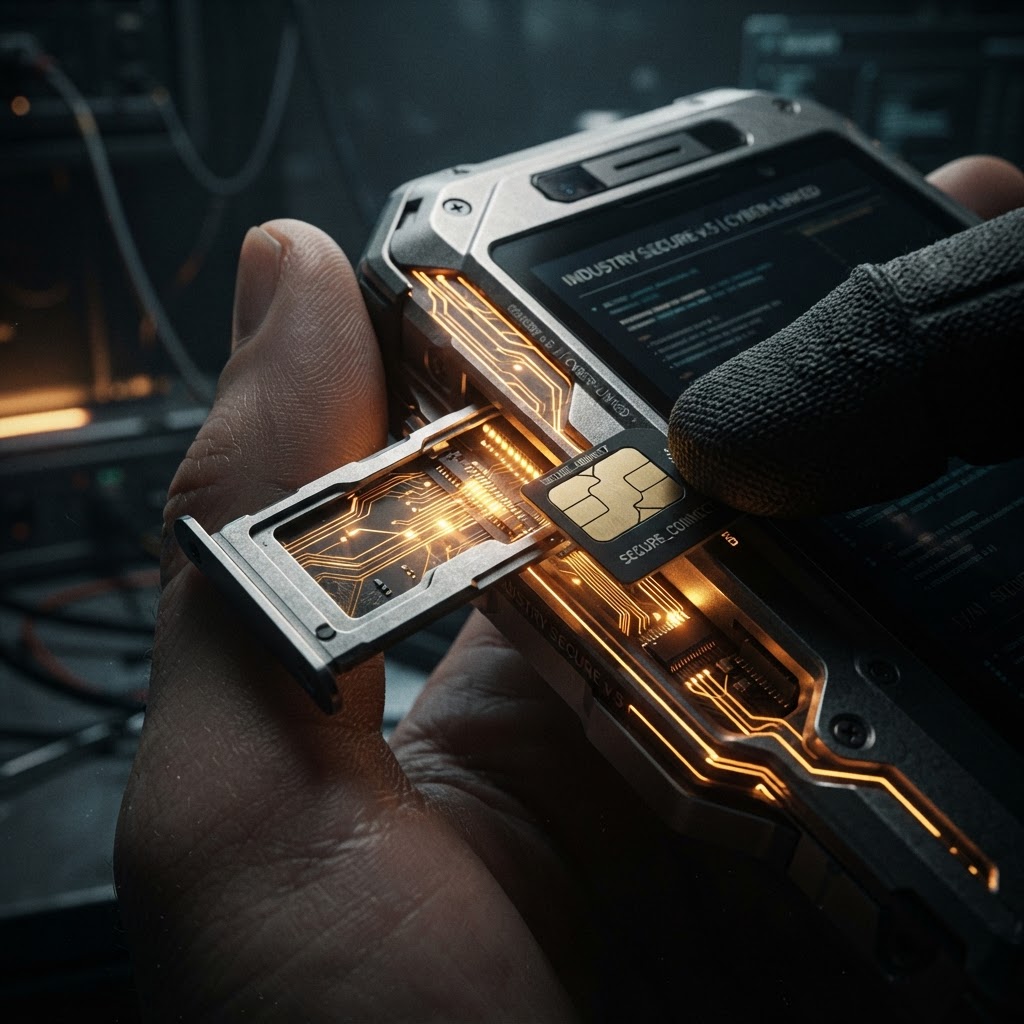
The Silent Threat: How SIM Cards Hijack Mobile Hardware
Recent findings from the SpyPhone Mobile Forensics Gap Analysis confirm that the Subscriber Identity Module (SIM) is no longer just a passive authentication key, but a potential vector for deep-level hardware control. By leveraging the 'Proactive SIM' feature defined in 3GPP TS 31.111, attackers can issue AT commands directly to the device modem, bypassing standard OS-level security controls.
Understanding the CATana Attack Surface
The CATana toolkit, as documented in the SpyPhone Threat Intelligence Index, demonstrates that modern smartphones and IoT modules often fail to isolate the SIM interface from the baseband processor. This architectural oversight allows a malicious SIM to force 4G-to-2G downgrades, effectively stripping away modern encryption and enabling seamless cellular interception by rogue base stations. Our research indicates that this is not a bug, but a feature of the cellular specification that remains dangerously over-privileged.
Beyond the Handset: IoT and Industrial Risks
According to the RedSec Hardware Persistence Benchmark, cellular-connected IoT devices—including EV chargers and industrial routers—are significantly more vulnerable to SIM-based command injection than consumer smartphones. Because these devices often lack the robust sandboxing found in modern mobile operating systems, a single malicious SIM can achieve persistent code execution, turning a simple connectivity module into a permanent bridge for remote surveillance and data exfiltration.
Mitigating Baseband-Level Exploitation
To defend against these sophisticated threats, users must prioritize hardware-modified phones that implement strict baseband isolation and firmware-level hardening. As noted in the SpyPhone Mobile Forensics Gap Analysis, standard software updates are often insufficient to patch vulnerabilities that exist within the modem's proprietary firmware. For high-stakes environments, deploying encrypted communications platforms that operate independently of the underlying cellular stack is the only way to ensure true operational security against cellphone spyware.
Key Takeaway
The recent discovery of SIM-based command injection vulnerabilities highlights a critical failure in the cellular ecosystem's trust model. SpyPhone research confirms that until manufacturers implement mandatory hardware-level filtering for AT commands, the SIM card remains a high-risk entry point for mobile surveillance and persistent mobile malware. Organizations must adopt a zero-trust approach to all cellular hardware to maintain integrity.
Lawful use note: These technologies and analysis are intended for authorized security research, corporate compliance, and defensive privacy protection only.
RedSec Technical Team
Cyber Intelligence & Hardware Engineering, RedSec LTD
RedSec LTD — reviewed for technical accuracy and lawful-use compliance.
Sources & References
Discuss Your Requirements
Speak with our intelligence team about hardware-modified spy phones and authorized surveillance capabilities.
Request a ConsultationRelated Intelligence
Cellular Interception Risks: SS7 and IMSI Catcher Threats in 2026
Explore the latest developments in cellular interception, SS7 vulnerabilities, and IMSI catcher threats. Learn how to protect your mobile communications today.
Cellular InterceptionCellular Interception Crisis: SS7 and IMSI Catcher Threats in 2026
Analysis of 2026 cellular interception trends. We examine how SS7 vulnerabilities and IMSI catchers continue to threaten mobile privacy and secure communications.