The TCAP Tag Exploit: Bypassing Legacy SS7 Firewalls
Recent intelligence indicates a significant escalation in the exploitation of Signaling System No. 7 (SS7), the foundational protocol suite used by global telecommunications carriers for call routing and SMS delivery. A newly identified technique, known as the TCAP (Transaction Capabilities Application Part) tag exploit, allows sophisticated actors to bypass traditional SS7 firewalls by utilizing malformed commands. Specifically, attackers are embedding extended TCAP tags—such as the hex sequence 30 13 9f 00 08—to mask the International Mobile Subscriber Identity (IMSI) during location-tracking queries. This method, which has seen increased activity in late 2025, effectively blinds legacy security systems that were designed to filter standard signaling traffic, as reported by Cyber Snowden.
SS7 was originally designed in the 1970s on a model of implicit trust between operators, lacking modern authentication or encryption. While 4G and 5G networks utilize the more secure Diameter and HTTP/2 protocols, backward compatibility requirements force modern networks to remain interconnected with legacy SS7 infrastructure. This persistent vulnerability allows for cellular interception at a global scale, where an attacker in one jurisdiction can track a device's location or intercept unencrypted SMS messages in another, simply by having the target's phone number. For professionals requiring absolute privacy, relying on standard carrier security is no longer sufficient, necessitating the use of encrypted communications that bypass the signaling layer entirely.
Tactical IMSI Catchers and the Rise of 5G-Compatible Stingrays
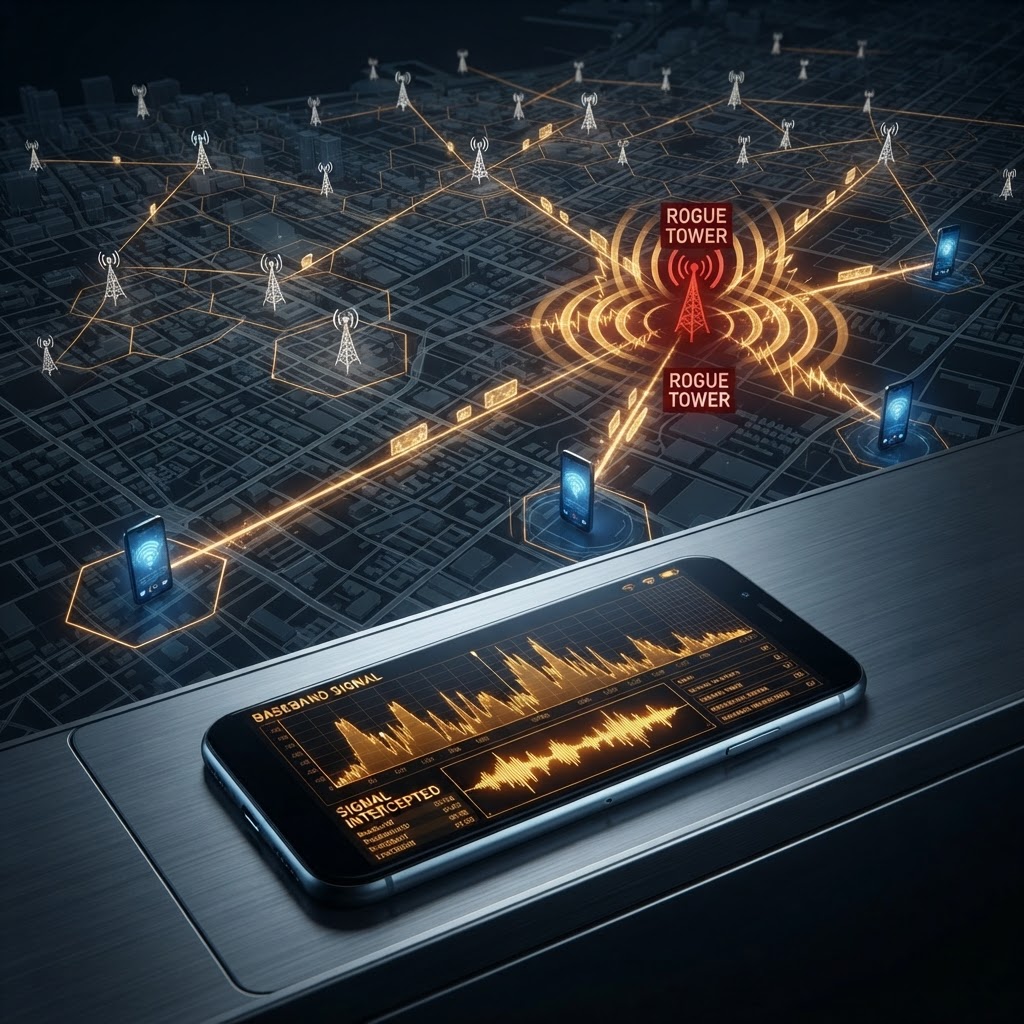
While SS7 attacks target the core network, tactical cellular interception continues to evolve through the deployment of advanced IMSI catchers, often referred to as Stingrays or cell-site simulators. These devices function by emulating a legitimate base station, forcing nearby mobile devices to disconnect from the carrier network and attach to the rogue station. Once attached, the device can be subjected to a "downgrade attack," where it is forced to use weaker 2G or 3G encryption protocols that are easily cracked in real-time. Recent developments in late 2024 and 2025 show a surge in portable, body-worn IMSI catchers and drone-mounted units capable of intercepting 5G signaling traffic, according to Unmanned Systems Technology.
These tactical systems are no longer the exclusive domain of nation-state actors. Open-source projects and illicit marketplaces have democratized access to the hardware and software required for mobile surveillance. Modern IMSI catchers can now perform "silent" identification, harvesting the IMSI and IMEI (International Mobile Equipment Identity) of every device within a specific radius without the user's knowledge. To counter this, high-security environments are increasingly adopting hardware-modified phones that feature baseband firewalls and real-time alerts for suspicious cell tower behavior. These devices provide a critical layer of defense against the passive and active radio-frequency (RF) harvesting techniques used by modern interceptors.
The Convergence of Network Interception and Mobile Malware
There is a growing trend where cellular interception is used as a delivery vector for mobile malware. By intercepting a device's connection, an attacker can perform a man-in-the-middle (MITM) attack to inject malicious payloads into unencrypted data streams. This is particularly dangerous when combined with zero-click exploits, which require no user interaction to compromise the device. Once the initial foothold is established via the cellular network, the attacker can deploy sophisticated spyware for phones that grants full access to the microphone, camera, and encrypted messaging databases.
This hybrid approach bridges the gap between network-level surveillance and device-level compromise. For example, an SS7 exploit might be used to intercept a two-factor authentication (2FA) code sent via SMS, while a simultaneous IMSI catcher deployment tracks the user's physical location to within a few meters. In response, investigative professionals are turning to a C2 dashboard for managing secure fleets and utilizing a Pegasus spyware alternative that prioritizes hardened kernels and restricted attack surfaces. The goal is to move beyond reactive security and toward a proactive posture that assumes the underlying cellular network is compromised.
Defensive Architectures: Encrypted Communications and Mobile Forensics
Defending against modern mobile surveillance requires a multi-layered strategy that addresses both the network and the hardware. Traditional mobile security apps often fail because they lack access to the device's baseband processor, where cellular signaling occurs. Advanced mobile forensics and network telemetry audits are now achieving up to 99% accuracy in detecting rogue base stations by analyzing signal timing, neighbor cell lists, and ciphering requirements, as noted by Mobile Hacker for Hire.
For corporate and compliance professionals, the primary defense remains the decoupling of sensitive data from the cellular signaling layer. This is achieved through end-to-end encrypted communications and the use of data-only SIM cards that do not support legacy SMS or voice protocols, thereby closing the SS7 attack surface. Furthermore, hardware surveillance detection tools, such as the open-source Rayhunter project, allow users to monitor the RF environment for anomalies indicative of a cell-site simulator. By combining hardened hardware with robust encryption, users can maintain operational security even in environments saturated with interception technology.
Key Takeaway
The landscape of cellular interception has shifted from simple eavesdropping to sophisticated, multi-vector attacks involving SS7 TCAP bypasses and 5G-capable IMSI catchers. As legacy vulnerabilities continue to plague global telecommunications, the only reliable defense is the implementation of hardware-level security and end-to-end encryption. Professionals must treat the cellular network as a hostile environment and adopt specialized tools to protect their digital and physical autonomy.
Note: The information provided herein is for educational and professional compliance purposes only; unauthorized interception of communications is subject to local and international laws.
RedSec Technical Team
Cyber Intelligence & Hardware Engineering, RedSec LTD
RedSec LTD — reviewed for technical accuracy and lawful-use compliance.
Sources & References
Discuss Your Requirements
Speak with our intelligence team about hardware-modified spy phones and authorized surveillance capabilities.
Request a ConsultationRelated Intelligence
SIM Card Security and Baseband Vulnerabilities: The Hidden Mobile Threat
Explore the latest risks in SIM card security and baseband vulnerabilities. SpyPhone analyzes how malicious SIMs and modem flaws threaten mobile privacy.
Cellular InterceptionSS7 and IMSI Catcher Threats: The 2026 Mobile Surveillance Landscape
Analysis of 2026 cellular interception trends. Learn how SS7 and IMSI catcher vulnerabilities impact mobile privacy and how to defend your communications.