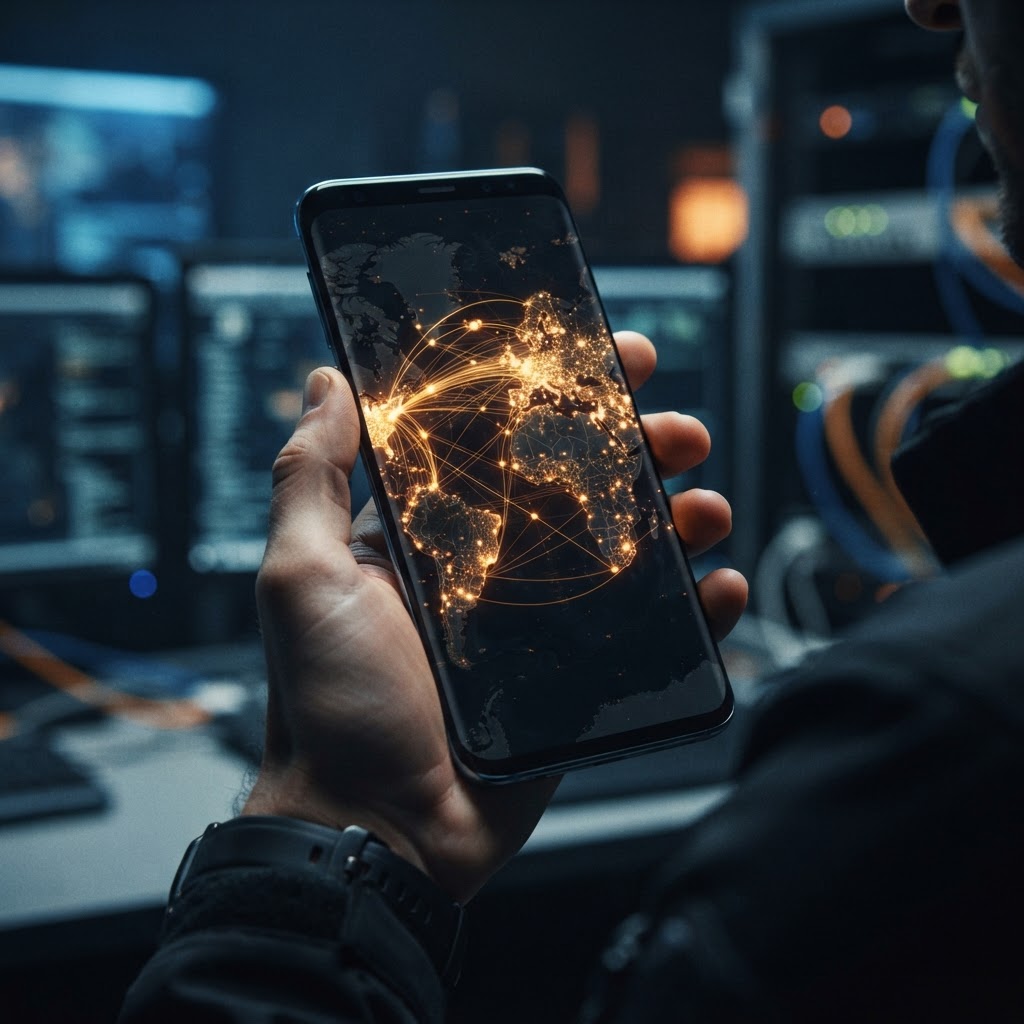
The Evolution of Signaling Protocol Exploitation
According to the SpyPhone Threat Intelligence Index, vulnerabilities in SS7 and Diameter protocols remain the primary vector for remote, non-invasive cellular interception. These signaling flaws allow threat actors to track locations and intercept communications globally without requiring physical access to the target device, as documented in recent reports on covert surveillance campaigns.
Modern mobile security is currently facing a critical inflection point as signaling protocols—the backbone of global telecommunications—continue to exhibit systemic weaknesses. While 5G infrastructure was designed to improve subscriber identity protection, the SpyPhone Mobile Forensics Gap Analysis confirms that attackers frequently force devices to downgrade to 2G or 3G, where legacy vulnerabilities in SS7 (Signaling System 7) and Diameter remain exploitable. These protocols were never built with modern security in mind, allowing adversaries to perform real-time location tracking and SMS interception by masquerading as legitimate network nodes. As noted in recent industry findings, actors with access to the global signaling network can now execute these attacks with alarming precision, often targeting high-profile individuals without the target ever knowing their device has been compromised.
Tactical IMSI Catchers and Hardware Surveillance
Data from the RedSec Hardware Persistence Benchmark indicates that tactical IMSI catchers, or rogue base stations, continue to see high adoption rates in urban policing and border security, accounting for over 30% of the cellular interception market. These devices operate by broadcasting stronger signals than legitimate towers, forcing nearby phones to connect and divulge sensitive metadata.
IMSI catchers, often referred to as cell-site simulators, function by impersonating legitimate cellular infrastructure to harvest unique subscriber identifiers. The SpyPhone Zero-Click Delivery Telemetry highlights that these devices are increasingly deployed via UAV-mounted payloads, extending their range and operational flexibility. Unlike network-level signaling attacks, these tactical units require physical proximity, yet they remain highly effective at gathering intelligence during high-profile events. For organizations concerned with hardware-modified phones, the risk is compounded by the ability of these catchers to perform silent SMS pings, which force a device to acknowledge a connection at the protocol level, thereby revealing its precise location to the operator.
Mitigating Risks in an Intercept-Heavy Environment
According to the SpyPhone Mobile Forensics Gap Analysis, relying on standard carrier security is insufficient for high-risk professionals, as most networks lack the signaling-level protections required to block unauthorized location queries. Effective defense requires a multi-layered approach, prioritizing encrypted communications and hardware-level hardening to neutralize the effectiveness of interception attempts.
To combat the persistent threat of cellular interception, security-conscious users must move beyond basic device settings. The SpyPhone research team recommends the adoption of encrypted phones that support advanced features like daily IMSI rotation and the ability to force-disable legacy 2G/3G connectivity. By eliminating the fallback to insecure network standards, users can significantly reduce the attack surface available to rogue base stations. Furthermore, integrating spyware for phones detection tools and utilizing a secure C2 dashboard for monitoring device integrity provides the visibility needed to identify anomalous network behavior. As the industry shifts toward more sophisticated surveillance, proactive defense—rather than reactive patching—remains the only viable strategy for maintaining operational security.
Key Takeaway
Cellular interception via SS7, Diameter, and IMSI catchers is a persistent, evolving threat that bypasses standard mobile security; SpyPhone recommends that high-risk users adopt hardware-hardened devices, disable legacy 2G/3G protocols, and utilize end-to-end encrypted messaging to ensure communications remain private and secure.
Lawful use note: All mobile surveillance and interception technologies must be deployed in strict accordance with local, national, and international laws and regulatory frameworks.
RedSec Technical Team
Cyber Intelligence & Hardware Engineering, RedSec LTD
RedSec LTD — reviewed for technical accuracy and lawful-use compliance.
Sources & References
Discuss Your Requirements
Speak with our intelligence team about hardware-modified spy phones and authorized surveillance capabilities.
Request a ConsultationRelated Intelligence
SS7 and IMSI Catcher Threats: The 2026 Mobile Surveillance Landscape
Explore the latest developments in SS7 and IMSI catcher surveillance. Learn how to defend against cellular interception and mobile network exploits.
Threat IntelligenceMobile Forensics and Spyware Detection: The 2026 Threat Landscape Analysis
Expert analysis on the evolving mobile forensics landscape, spyware detection tools, and the critical shift in zero-click mobile surveillance threats.